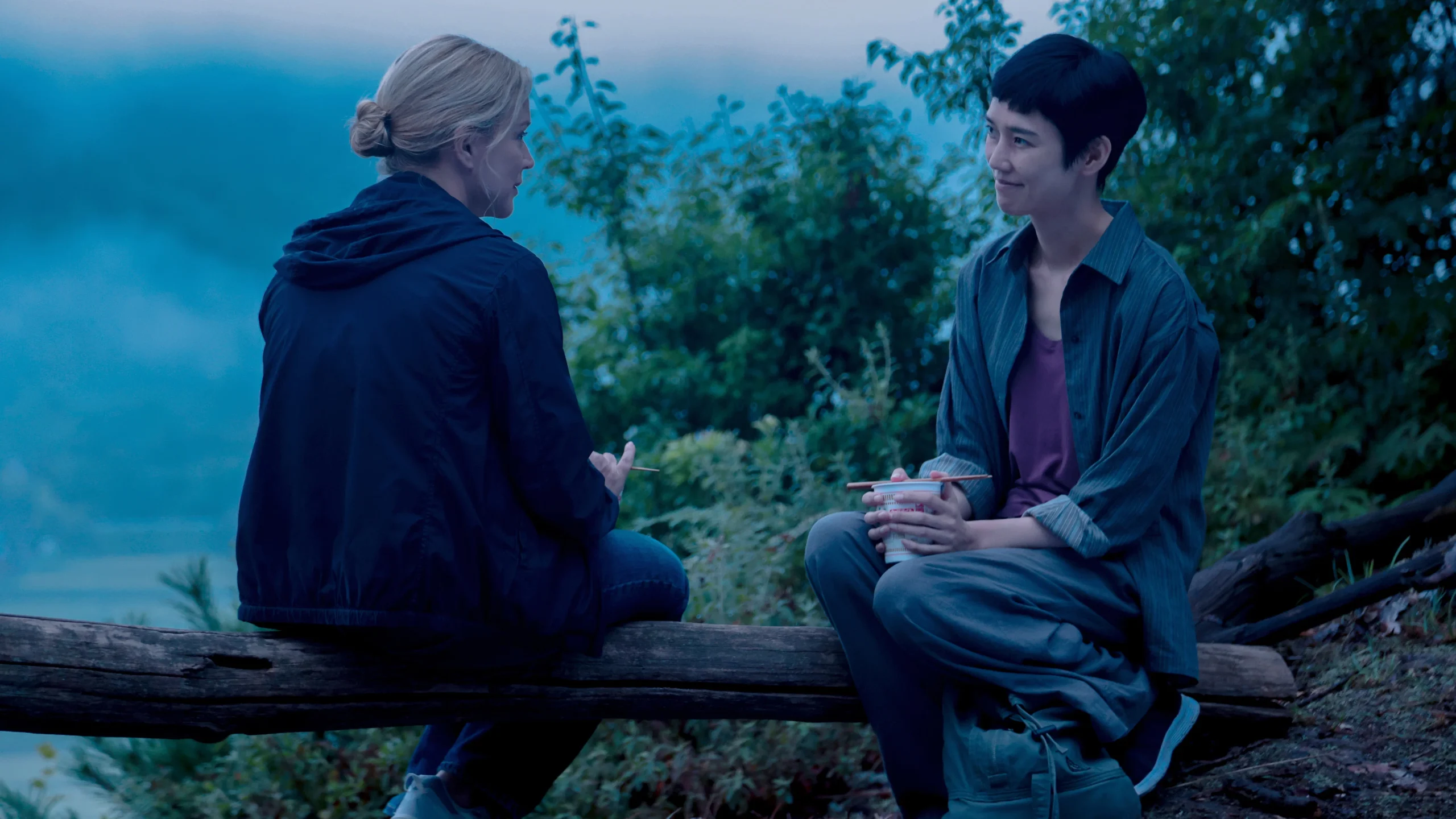
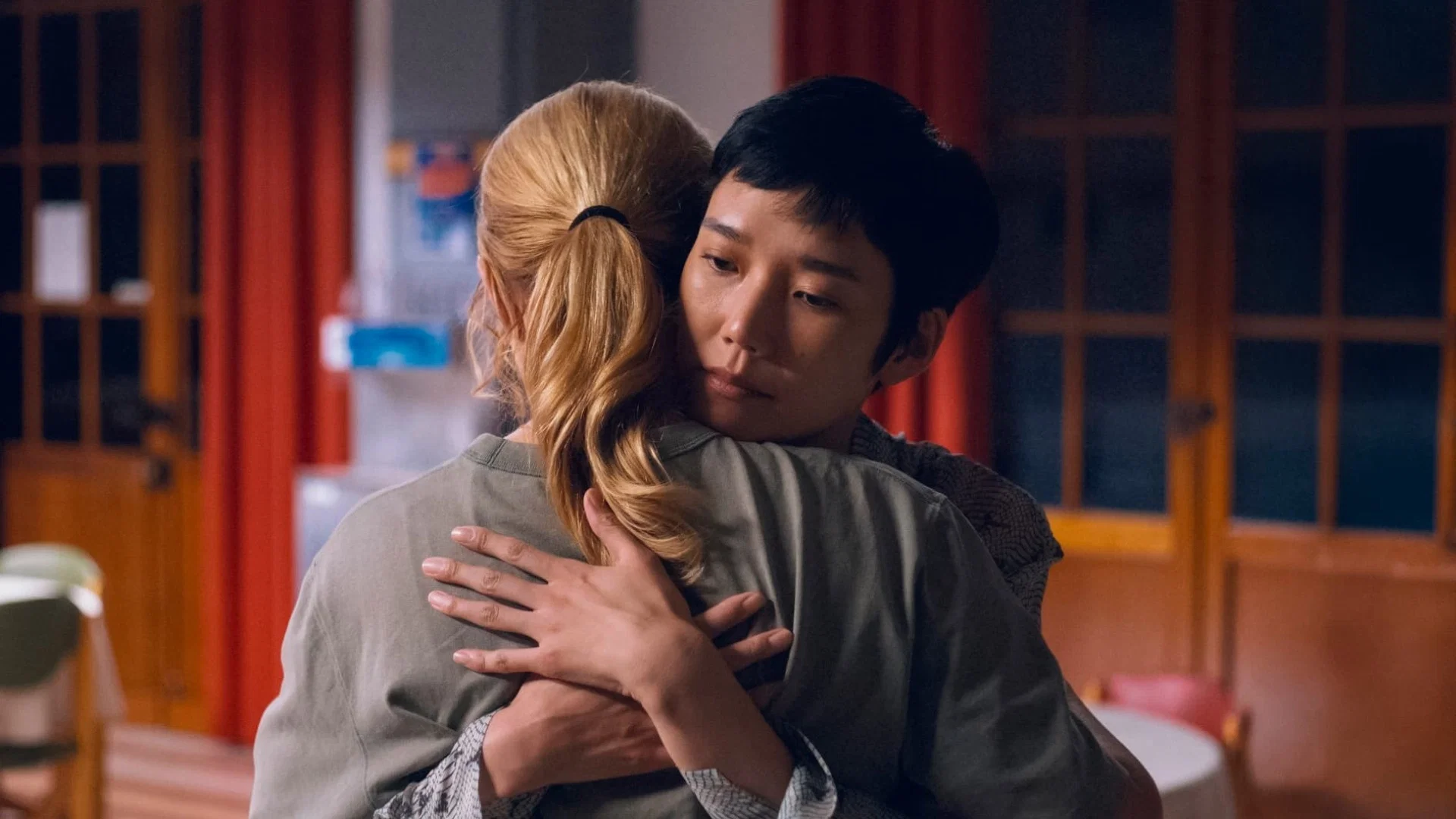
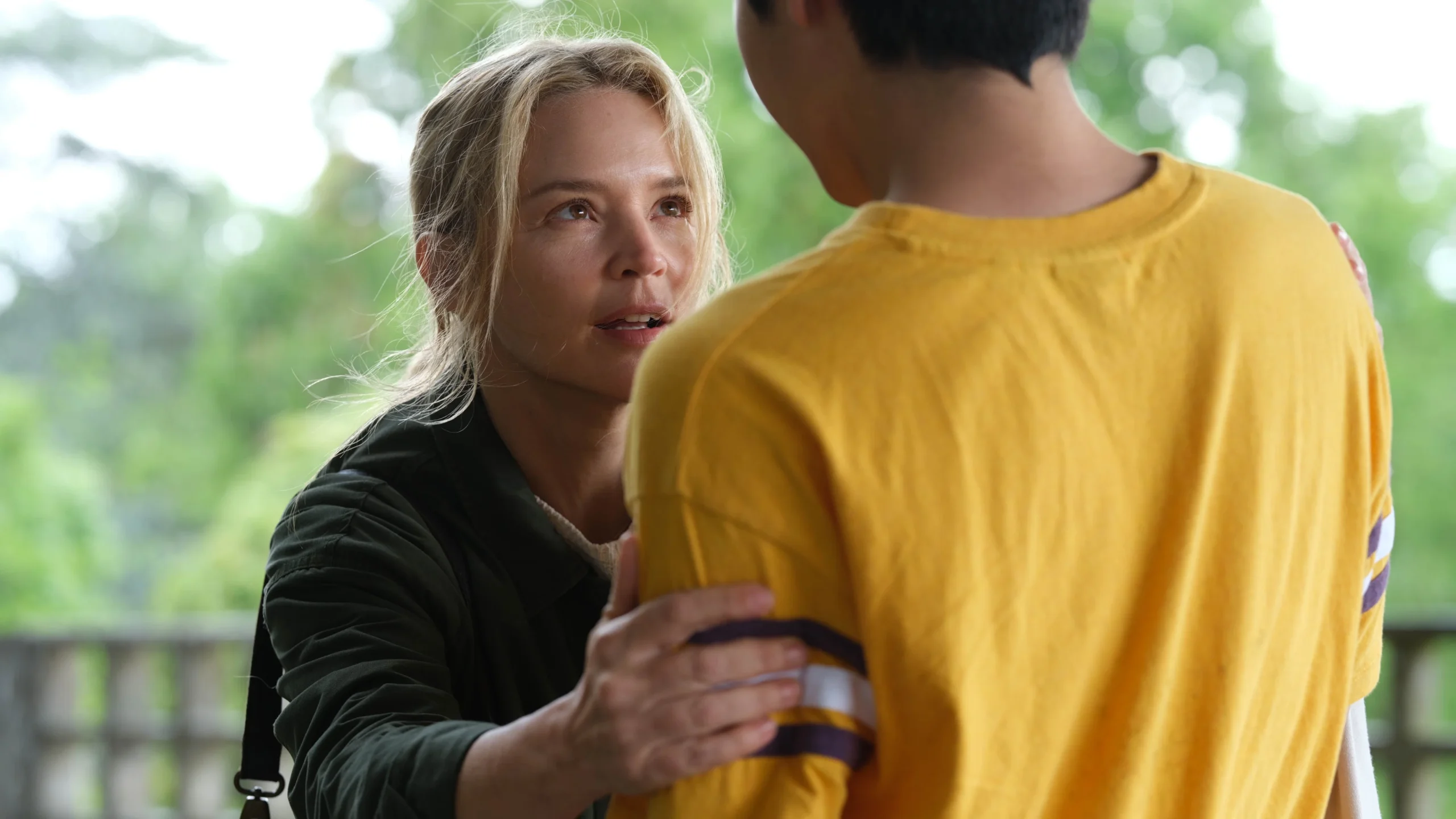
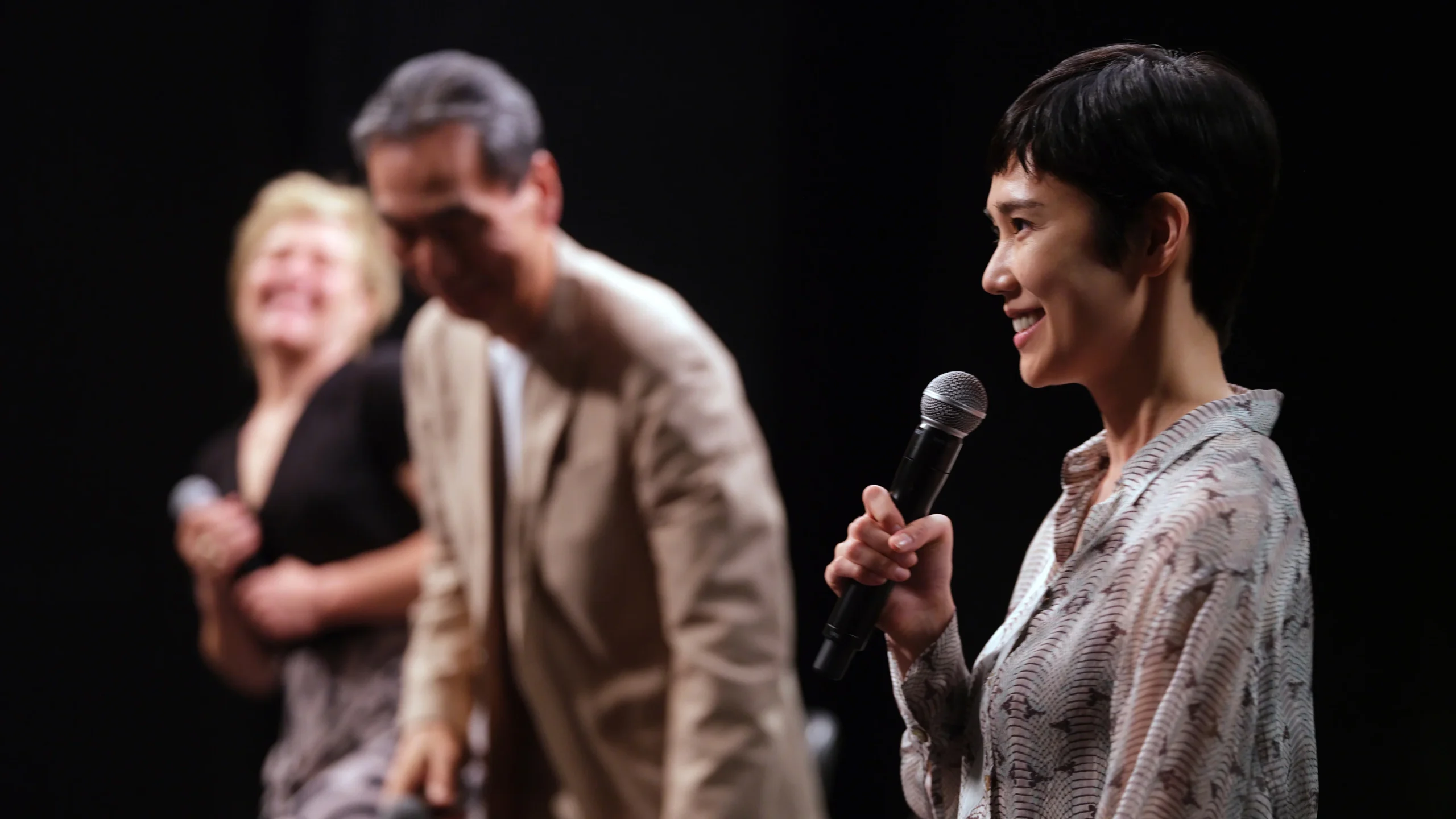
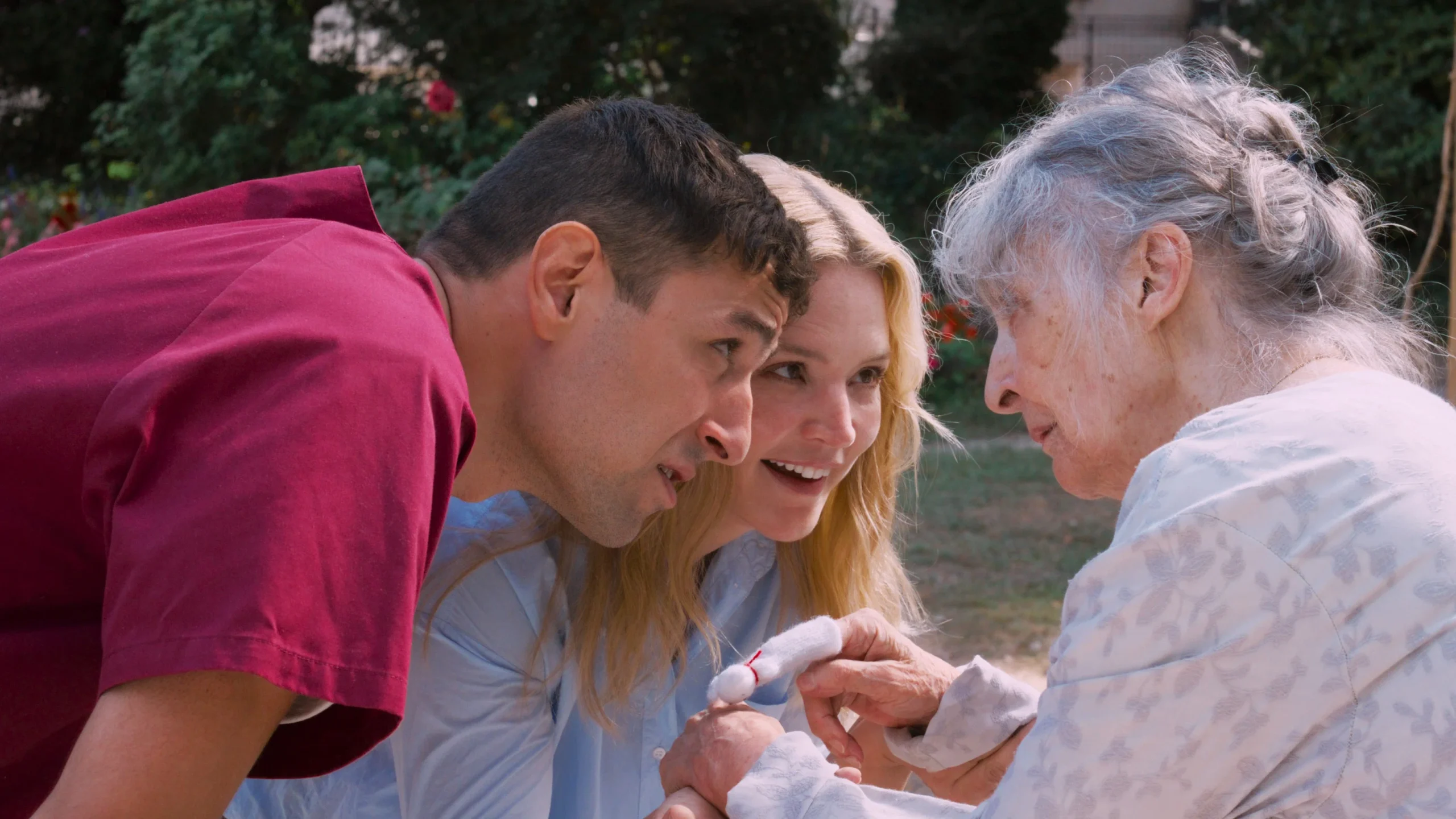
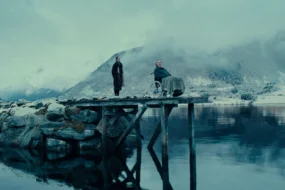
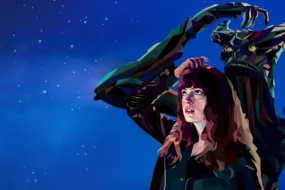
If Fjord according to us delighted the palm gold to Suddenly, our favourite of the Cannes festival, the last film by Ryusuke Hamaguchi did not go back to bragging. Suddenly is carried by two actresses in tune, the French Virginie Efira (Marie-Lou) and the Japanese Tao Okamoto (Mari) who each received the prize of female performance. A natural choice while their performance cannot be conceived one without the other. Suddenly is a grand film where the sensitive gets married to politics with a confusing virtuosity. Director of EHPAD, Marie-Lou was keen to set up a more human philosophy in this end-of-life institution subjected to the ruthless shareholder pressure. A meeting all the more fortuitous with Mari will upset the trajectory of both women as if the « objective chance » They had gathered them together by the death that awaits: the death of the others who suffer by ricochet and the death that strikes us suddenly. More than a solar film, Suddenly is an apprenticeship aimed at diverting our gaze from ourselves to find the other.
Meet the other
Sordain tells the meeting between two women. The term is somewhat confused today in a society governed by the mobilization of the « free time » to recovery, consumption and distraction to forget the periods worked. Here we have to hear the word « Meeting » as a space-time sequence that involves a collision between the parties involved. The opportunity cost is zero: it is not about losing or winning something. On the contrary, it is a matter of revealing a hidden reality of oneself but also of the other. « The meeting corresponds to this moment, the event that culminates in the precise moment when individuals meet each other ». This space-time is marked between France and Japan, between life and death; The meeting place is the theatre. An encounter, therefore, is to confront otherness. They are individuals who shape a new identity around reciprocal exchanges.
This meeting presented by Hamaguchi frees itself from any commercial purpose, in the sense that it is not a matter of producing or ripping something from another, but of a sincere exchange. The encounter in the original sense therefore proceeds from symmetry, where one of the biases of our postmodern era tends to reduce it to a utilitarian function, productivity being authentic. To illustrate, meeting someone on Tinder is precisely met no one, the chance being caught by a partial algorithm on one hand; the criteria are defined by an object defining the relationship sought on the other hand. Here, there is no point in defining the very nature of this encounter, nor of knowing whether these two women have a relationship of love, friendship and/or sorority. The reality lies in these three modalities, without ever having to decide. Hamaguchi brings the nature of exchanges back to a human dimension that is sorely lacking in the present time.
The whole society rejects the alienated
In her EHPAD, the situation differs significantly: Marie-Lou is taken hostage to her status as a manager. It must produce results and satisfy the residents·e·and as his servants. When she meets Mari, « a director who puts life into practice and a cancer woman who refuses to die », time resumes its first dimension, in the sense that its boundaries define a beginning and an end, therefore the potential of any future enterprise. « Enjoy » Please say today in the absolute form of a verb immediately deprived of any particular object. But what or just who? Hamaguchi refuses to reduce time to any profit and that is what makes the encounter so singular. It is because it exists and that is enough.
Directly concerned with the death that awaits him at the end of his cancer in phase four, Mari naturally maintains a special relation to life and death. It is that the outcome is known. Even though the spite of irremediable lapse is real, this Japanese director radiates as if every moment was an epiphany, recalling how precious life is. Marie-Lou, for her part, maintains an indirect relationship to the death because of her office and her unwavering commitment to the benefit of the residents.·e·s, not hesitating to blur the boundaries between staff and professionals by living on site.
Widely worn by his dialogues during nearly 3:20 a.m., when all notions of time seem to pass away, Ryusuke Hamaguchi's film once again has a special relationship with the theatre. Again, as the theatre already occupied a central place in Drive my car as the filmmaker acknowledges. While he was looking « a matter that can resonate with the concerns of the film »Hamaguchi ran into Psychonautica, a book by Japanese researcher Takeshi Matsushima on psychiatry in Italy and the figure of Franco Basaglia, the man who abolished asylums in Italy. This piece that does not exist as an autonomous work appears in the film when the two women meet during the performance. It was used as raw material for film design. Adapted from the correspondence book, When life takes an unexpected turn Makiko Miyano and Maho, Suddenly based on a second « non-fictional material » of which the filmmaker has largely freed himself. Hamaguchi explains his approach to stay close to the spirit of the book while transforming reality « to make exist in cinema what [he] seemed to be the essence: the encounter ».
Meet your character
On all levels, Suddenly is a meeting, first between actresses who did not each know a word of the mother tongue of the other. « One was almost zero in Japanese, the other almost zero in French » Explains. Two months is the time it took Virgin Efira and Tao Okamoto to learn the basics of both languages. Their characters constantly switch from Japanese to French in a perpetual movement towards the other. Before the filming, the filmmaker gave a text with a battery of about twenty questions concerning intimate areas. « The relationship to sexuality, to what counts, to certain choices, to certain areas of silence » explains Virginie Efira exit transformed by the role. « The character answers or does not answer. And this too is very important: what he does not say, what he bypasses, what he leaves in the shadow. The text is beautifully written. But it should not be used as a simple psychological biography. »
« Rather, it is a question of bypassing the character's mystery without ever pretending to solve it, of approaching it without reducing it. »
Virginie Efira
Where Hamaguchi and his writer Léa Le Dimna are excellent, it is that they have succeeded, together, in making the camera completely erased to better reveal the characters thanks to the correctness of the dialogues. Most of the scenes required a dozen shots and the intellectual exchanges between the two women show an amazing authenticity. Music is rare, if not discreet, so as not to distort emotions. The Japanese filmmaker was delighted with the conditions of filming in France. Directed between Paris and Kyoto, the shooting of Suddenly seems to have given the two actresses the time to really meet, where most of the films do not enjoy such generous production conditions. The two women raise an extraordinary collective atmosphere during the shooting, each scene culminating in a general applause of the plateau composed of so many professionals·l·resident only·es real·on·s.
«We live in a societal system that robs us of the time when we could pay attention to each other. »
Ryusuke Hamaguchi
In Hamaguchi's film, time seems suspended. And because of this, dawn is systematically confused with dusk. When both women experience the practical limits of their critical thinking, theoretical discussions encounter the hardness of reality. How can we remain competitive in the eyes of EHPAD shareholders, without falling into abuse? Especially cerebral, Suddenly However, it is never verbose, even when it comes to proving the harmfulness of the capitalist system in a relentless demonstration. Mari was trained in the philosophy of Sorbonne University, Marie-Lou in anthropology after an international course in Japan. Both women are naturally more than familiar with Marx's theory of value, a prerequisite for any critical thinking of the system that governs us, otherwise the very object of criticism is sterile.
Applying Humanitude Principles
Where Suddenly strike straight in the mile, that is that he manages to draw a path that does not limit either fatalism or utopia. In the face of a capitalism by nature predatory and whose metabolism consists irreparably of the accumulation of capital in perpetual growth, Mari gives us a lecture on the intrinsic functioning of an economic system founded to satisfy an increasingly residual minority. This transfer of communicating vessels, from the labour force to capital, from the outside to the inside, from the countryside to the cities, from the countries of the South to the countries of the North and so on, suffers from a new planetary limit: the depletion of natural resources, an infinite growth in a finite world being inevitably doomed to the collapse of the system.
If this prodigious passage will be able to rid the novices of its didactic nature, Hamaguchi succeeds in making this lighting one of the pivotal scenes of the film. Mari does not claim to revolutionize the mode of production and distribution of wealth at macro level, recognizing that it is the same system that allowed him to reach here. However, by having fully grasped the determinants of capitalist predation, which at first consumes the margins (minorities) until everything swallows in its center, Mari weighs what belongs to him and what escapes him. She therefore knowingly knows the limits of her own power and her human condition.
In the original sense of the Greek term of organizing the life of the city and living together as a community, its political action incorporates the material constraints inherent in superstructures. Understand that there is no political action that is worth regardless of the external forces, which seems to escape some of the policies that claim themselves from the left today. In this, the film of Hamaguchi is a lesson in materialism applied to finitude. The Boetia teaches us that our voluntary servitude depends first of all on our consent to this scheme of hardship, where each stratum oppresses the lower echelon, consciously or not. In SuddenlyIn order to set up humanity in the EHPAD she runs, Marie-Lou should therefore train the health care teams, temporarily increase their workload, and therefore risk seeing the rate of resignation of the service rise. Through this game of multiple hardships and the development of this vicious circle, those who hold capital would not fail to put an end to human initiative.
To end the confinement
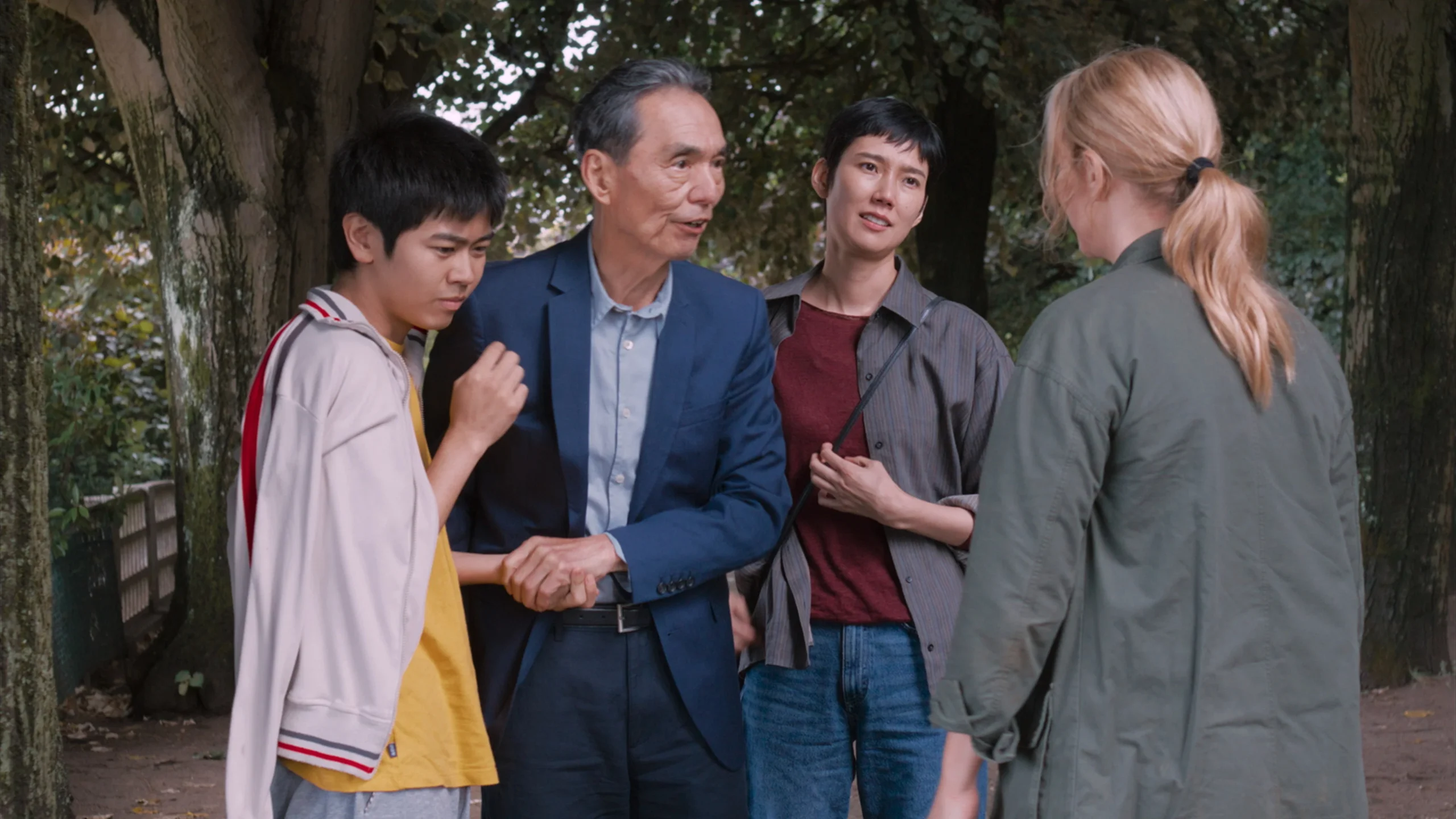
If this encounter occurs in theatre, it is not annoyed. In Greek, theatre is « the place where we look ». The theatre is born from the encounter between someone who shows and someone who observes, here between the director Mari and the spectator Marie-Lou. The comparison becomes all the more interesting since it is in a room where the boundaries between actors and spectators are abolished that the two women meet. The audience is invited to play instruments, a child with severe autism wanders according to his will, while his grandfather declames on stage that it is necessary « putting life into practice rather than thinking it » while pretending to ask one of the only questions that determines all the others:
«Are healthy people really alive? »
Character of Goro Kiyomiya performing the play in Suddenly
This is what it is about. « Inside and outside... Mix all » Did he profess on stage and later in the institute of care for the elderly. « We will open another way for the world ». From this human encounter, the problem finds a solution that consists of abandoning ourselves to our common humanity. The alien of Basaglia is to be understood as an inadequate rather than a madman consumed by this dilemma: « Either he kills himself or he kills those who lock up. » The meaning of the word « Alien » is dual. In the image of Antonin Artaud subjected to electroshocks, it is this inappropriate taken for a fool that is separated from the others, as well as the alien theorized by Karl Marx. He no longer recognizes himself in the product of his work of which he is dispossessed, or in his productive activity where he is objectified by the term human resource. In the final stage, the alienate no longer identifies himself as one of his fellows, though from the same social class, trade being reduced to a utilitarian function of the products of exploitation of their labour force.
Meet yourself
To protect oneself from alienation, Hamaguchi proposes an intellectual journey aimed at overthrowing the pyramid by reconnecting with the other. Driven by a rigorous mechanism from beginning to end, Suddenly is also revealed by the detail of the cut of the film by dates. Time is useful only to understand fate. The events of Suddenly unfold throughout the film until this undated epilogue, where time no longer matters as if it were to escape the present time. The capitalist system « steals time » because of its very nature: to increase the share of capital, one must reduce the share of labour; « be more competitive » They're willing to say. And to consume and maintain the machine, you have to work, alienate and therefore separate and others and yourself.
A sign of consubstantial greed in the system, it is a question of colonizing new spaces by invisible work carried out without our knowledge outside the original place of production. Once freed from time, the film reaches a form of state of grace where there is no waiting, nor regrets. Hamaguchi creates a space-time where the subject is confused with the other, Mari and Marie-Lou becoming characters among others. Suddenly is a film lesson as much as a manifesto to recover our humanity. A film to support absolutely in the theater.
Analysis of the latest gold palms 🌿
And other cannois critics
- Minotaur, Zviaguintsev special domestic operation
- Roma Elastica, the martyrs of postmodernity
- Her Private Hell, operating pop opera or aesthetics at the service of vacuum
- Parallel stories, tales of stallors
- Yes, overview of submission: impossible happiness
- Put Your Soul on Your Hand and Walk – To suffer with, to live without
- The Zone of Interest, an ordinary monster's ice journal
- The seeds of the wild fig tree, anatomy of a revolt?
- The last little, obeying that oneself (inshallah)
- Emilia Perez – Changing bodies is changing society
- Black Dog, bitch of life but rage to live
- The Shameless, caste prostitution: from shame to spark?
- Eddington, America is afraid
- Sirāt, flight line to absolute
- Die, My Love – Cartography of an upset desire
- The disappearance of Josef Mengele, autopsy of a Nazi officer
- sentimental value, the weight of hereditary melancholy
- The Apprentice, a harmless biopic on Trump's dog?
- The Shrouds – Open tomb
JV critic and film always ready to lead Interviews at festivals! Amateur of genre films and everything that tends to the strange. Do not hesitate to contact me by consulting my profile.
Categories
Recent Posts
Does Saros eclipse Returnal?
- 4 September 2026
- 12 min. reading
The 4K Ultra HD Bazaar, volume
- 31 August 2026
- 75 minutes. readable
Harmony Korine, a cinema for those who
- 20 August 2026
- 13min. reading
Suddenly, the lesson of materialism applied to the
- 19 August 2026
- 15 min reading
Fjord, defining violence: cultural impasse?
- 18 August 2026
- 26min reading


In 3h16 suspended, this masterpiece unfolds a vibrating meditation where finitude becomes tiny laboratory of utopias. The gestures, such as a foot massage, a burst of laughter, or an idea that circulates, draw a policy of the sensitive, as if capitalism were in the midst of mildness. Two women invent a lightning fraternity, almost solar, where humanism learns step by step. Ryūsuke Hamaguchi orchestrates all this with an aerial grace, and his film, large and benevolent, irradiates long after.