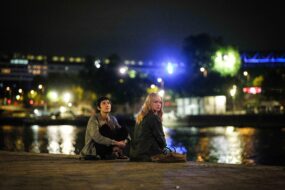
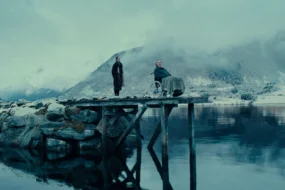
Celebrated at the last Cannes Festival, from which he returned to the Grand Prix, the new feature film by Joachim Trier, entitled Affeksjonsverdi in its original version, releases, in the image of the traditional characters dear to the Danish-Norwegian director, an emotional power as shocking as contained, through the history of a family where absence has left cracks.
Back to Oslo
Four years after the international success of Julie (in 12 chapters) (unforgivable translation of the much better Norwegian title) Verdens verste menneske, or The worst person in the world), which came to conclude a trilogy of Oslo with contemplative melancholy, and whose summit will forever remain the magnificent Oslo, 31 August, Joachim Trier returns to his heart for a film that seems to be the culmination of his introspective and disenchanted cinema. After the death of their mother, the two Osloite sisters Agnes and Nora (Renate Reinsve, the eternal muse of Trier), confront their father, Gustav Borg ( immense Stellan Skarsgård), a former world-renowned filmmaker now fashioned, who never knew how to be present for them. But when Nora, a professional actress, is offered to play in a final film he wrote for her, old wounds are reopened and distant secrets emerge from the past.
The absent are always wrong
The film opens up like a tale, with a voice-over that introduces Nora and her family through their home, the atmosphere that emerges from it, and above all, from this crack that runs from the foundations to the top floor – for generations. Concrete incarnation of the Borg family traumas, this great building, however majestic, is described by little Nora as a conscious being, capable of experiencing suffering, like its occupants. The staging is then palpable, the camera filming as close as possible the walls, the doors, and the parquet, like as many skin surfaces as parental disputes could in turn peel. But once the father leaves, the pronounced divorce, the noise of cries is no longer, only silence, perhaps even more deafening, and absence, more perceptible than ever. During these first retrospective moments, the father hardly appears on the screen, except in rare fleeting planes, while the camera taunts at length on the many pieces of this vast home, now emptied of its human warmth.
In the present, the house remains that roof that was once inhabited, but that holds nothing, or anyone. The two sisters met there to decide the fate of the family taverns. Nora doesn't want anything except maybe this red vase, but only because his little sister Agnes, whom she loves so much, said she looks pretty, lending him a sudden sentimental value that he didn't have a few seconds earlier. What would have happened to Nora without Agnes? Local actress, resident of the national theatre of Oslo, she only stands up through her performances, these eternal false-likers. Panic before entering the scene, one sees her trying to tear her costume, before getting repaired by the small hands, who place pieces of scotch all over her body as if to close a leak that one knows irreparable. But sometimes this is enough, at least the time of a performance.
For her part, Agnes chose stability, she married and had a child, young Erik, whom Gustav also coveted to play in his film. How did you manage to build a family after the childhood we had? Nora asks him. We didn't have the same childhood, Agnes says. I had you. But who was watching on Nora? Certainly not their mother's psychologist, too busy listening to his patients to listen to his children, and much less their father, this tormented artist who went while they were still young, this father who took advantage of his ex-wife's funeral to get back to the cellar two huge speakers, listening tools far too high in range for a man who never listened to his own daughters. You're the best thing that ever happened to me, says Gustav, on the evening of his grandson's ninth birthday – to which he offered DVDs, including The Pianist Haneke. So why weren't you there? An artist cannot be burdened with the daily hassle of the petty bourgeois, then pleads Gustav with a smile in the corner, giving a scornful look to his son-in-law.
But this scenario he wrote is magnificent, Agnes must be reluctant to admit, after reading it. This film he wrote for Nora, in which he indirectly evokes his mother, who took away his life when he was only seven years old, this film seems to tell his daughter, whom he knows no more. And if, as he grew deprived of a mother, unable to give to his eldest woman what he did not receive himself, he had in turn transmitted to him his loneliness, this latent melancholy which he channeled through his art, like a poisoned legacy, an inevitable legacy? This final film, he cannot do without her, and even the talented Rachel Kemp (camped by the moving Elle Fanning) becomes aware of it, as Gustav pushes her to turn into a carbon copy of Nora. With cinema for one language, he sees in this film a last chance to reconnect with his daughters, by making Nora and the son of Agnes play there, in the hope of reviving this paternal bond that should have bound them forever.
Hearts that Resonate
The accuracy and elegant restraint that Joachim Sorter deploys in Sentimental value make this film its most accomplished work, a concentration of its melancholic and urban contemplations, a universal narrative that will resonate in most hearts. Sublimated by the delicate piano notes of the Polish composer Hania Rani, her gaze manages to grasp often striking plans, where emotion reveals itself through a braiding mouth, a running look, or a smile finally sincere. Almost perfect from end to end, and carried by actors at the top of their art, Affeksjonsverdi may well be the masterpiece of his director.
Devouring twilight films, night literary translator and self-proclaimed specialist of Icelandic cinema, I track feature films at night and day, but especially at night, in order to draw from them the substantial mellow necessary for the survival of the hungry cinemaphile.

Categories
Recent Posts
The 4K Ultra HD Bazaar, volume
- 30 April 2026
- 50min. readout
Raw pearl polished with roguelite : Absolute, the
- 24 April 2026
- 14 min. reading
The Mag.7: a selection for the Myceliads
- 15 April 2026
- 25min. readout
Expressionism in cinema: crises and
- 13 April 2026
- 20min reading
South Park: The Stick of Truth,
- 1 April 2026
- 12 min. reading


Well seen the speakers haha. And thank you for this beautiful review that already makes me want to see him again!