Presented in preview at Star Saint-Ex in Strasbourg, Put Your Soul on Your Hand and Walk traces the daily life of Fatima Hassouna, a young photojournalist trapped in the « Gaza Prison ». A fruit of a meeting between two women, this burning documentary is based on a simplistic device: two smartphones, two faces with one side, Sepideh Farsi, Iranian director and dissident; and the other, Fatem, a Gazawi artist who dreams of seeing the world and tries to document the calvary, the joys and sorrows endured by his people. The night following the selection of the film at ACID at the Cannes Film Festival, Fatem was killed under Israeli bombs. The young woman adds to the countless peaceful victims and resistors silenced by the ongoing genocide.

Support the horror of reality

We were looking forward to attending the Put Your Soul that we missed in Cannes. On the one hand, Fatem's murder had led the festival to pay tribute to the young Gazawi during the opening ceremony; on the other hand, the press conference of the film had to be cancelled at the last moment. It is the night before that the hotel the Majestic had cancelled the reservation on the pretext that the event was « incompatible with [its] customers » As Mediapart reported in its columns. One « double standards » evocative of one of the many signs of the bankruptcy of the West and hypocrisy when it comes to reporting Apartheid and violations of the rights of the colonised, a fortiori when it comes to Arabic.

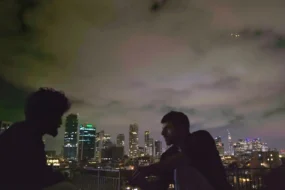
On the left, Sepideh Farsi raises his fist in support of his friend Fatem, killed under the bombs the day after the announcement of Put Your Soul's selection in Cannes. On the right, one of the sequences of the film where the two women exchange, support and dream of a desirable future.

« Why does cinema, a breeding ground for social works, seem to be disinterested in the horror of the real, in the oppression suffered by our friends and sisters? » The group asked about 380 artists who signed the Hall against « the silence of the world of culture in the face of genocide ». « Ten of his relatives, including his pregnant sister, were killed by the same Israeli strike. » They added in this late text – however essential – recalling the evidence that other people prefer to silence: Fatem was murdered because his testimony bothered, all the more so after the Cannoese selection of Put Your Soul. His work of documentation was to disappear, like that of hundreds of journalists, UN personnel, humanitarian workers, doctors, intellectuals and artists eliminated against all the rules of the law of war. « They took us away. » Sepideh Farsi, moved at the end of a suffocating session, which resulted in a thunderous applause.

Those who read us know how dear we are to this articulation between cinema and real, in documentaries and fictions. We used to invoke many times, long before the Cannoese celebration, caught up in repeated massacres. How can we get out of the ever more unsustainable, but incapable of influencing a political discourse that is complicit in IDF abuses? What path does the cinema have to take to represent the horror of reality and to break the memory impasse? What role should the seventh Art play, or rather, while the paradigm shift in international relations obscenely manifests its will to free itself from the framework of international law with impunity? So many open questions that certainly imbued the creative process of Put Your Soul in a degraded context, between impotence and fierce repression against solidarity movements against the Palestinian people. In France as elsewhere, their supporters are immediately taxed anti-Semitism when they are not benignly associated with blind supporters of Hamas.

A contemporary moment in history

Two years before Put Your Soul, Jonathan Glazer's latest film was a useful first reading grid ; the question of Conjuring the logic of genocide Crossing The Area of Interest during his screening in Cannes. The British director then refused to confine the word genocide to the Holocaust alone, today « embezzled by occupation ». It was clear, however, that it was strong criticisms of his peers A year before this rostrum. We have to get out of « the fetishization and spectacularization of genocide » so that « this catastrophe is not a calcified moment of history, that it is not enclosed in a bubble d'amber ». In an interview awarded to the newspaper Le Monde, the filmmaker rightly added: « We need her to guide us for the present time. » as we noted, too, in our critical The same argument (and inept objections) followed before Glazer's clarification.

The deliberate use of the word genocide, the object of all sterile semantic argutes, is intended to prohibit the occurrence of the crime, rather than to wait for it to be fully consumed, which seems to be of little concern to the « Still ». Language also conditions reality. Put your soul presents a look Contemporary of the Palestinian Genocide.

The Area of Interest
The word catastrophe has a double semantic dimension, both of a drama past like that of an unquestionably future event. Genocide is not exclusive to the Holocaust, questions Glazer in the Zone of Interest.

Can we support the assumption that political inaction would result from the lack of direct images of Gaza? The answer is obvious as it is enough to open up social networks to see what other people choose to ignore because (in particular) of a neocolonial atavism coupled with an Islamophobia almost institutionalised in France (read La Haine, six months of Islamophobia in France on Mediapart). On the question of the strength of images, the docu-fiction 2073 (read our critical) proposed a path which did not seem convincing enough to us at the Venice Mostra, mobilising, with great reinforcement of contemporary shock scenes, the viewer's feeling of injustice. Yet the logic of the baton had seemed futile to us at a time when it was not the lack of images but its overabundance. A strategy of shock that petrifies more than it mobilizes many disillusioned citizens.

Published in newspapers around the world, the photograph of Kim Phuc, a 9-year-old girl, running naked and burned on June 8, 1972 by a napalm attack, was a turning point in world public opinion. Between 1 and 2 million civilians died during the Vietnam War, the genocidal character of which is still the subject of much controversy today.
In France, despite the abundance of videos and photos without filters on social networks, speaking time and images of Palestinians killed since 7 October has been used as an exception in the national press in contrast to other neighbouring countries less subject to the process of humanisation of Palestinians.

Evidence of this, the little girl in Napalm is enough to shape public opinion against the Vietnam war; a contrario thousands of video evidence fail to reverse the media discourse today. A question that is all the more urgent, since Art seems often overtaken by events, making any attempt to transform imaginations towards possible less barbaric and Manichaean. We see a new « Axe of evil », deposed on the post-September 11, 2001 propaganda and its preventive wars whose aftermath is known. History seems to repeat itself tirelessly. Yet, despite this partial failure of part of film production, some engage without concessions to move the lines. This is the case with the film. Yes of the Israeli Nadav Lapid who denounces the « tears of the occupant » of its congeners caught by avenging appetite as Put Your Soul of Sepideh Farsi, who manages to draw a singular path by giving the word to the Palestinians. Denounce on one side, reach out to the other.

Yes de Nadav Lapid destroys the obscenity of the victim narrative of Israeli society, today mostly dislodged by contrary feelings: hatred, fear and revenge. Fiction joins reality with scenes celebrating genocide adapted in the film. « Reign, submission is happiness » launches one of the cynical characters of this political burn.

Clear other

Clearing the other is the essence of genocide, which appears immediately in the film by Sepideh Farsi. « They want to take everything from us, even our currency » Fatem, while she explains that she has to pay in shekel for the few things that still have to be consumed in this open prison which has become « die », as Sepideh Farsi explained during the preview. « But they will never have our joy to live » adds Fatem, proud of his country. Behind the pixels, despite the fluttering connection, there's still this radiant smile of Fatem, as if his joy was the last thing that could delight him « The occupying army », a term that never fails to remind the lucid young woman. « The occupying army », proscribed by many commentators, as if it had all begun on October 7, 2023. Fatem never left Gaza. The blockade had begun in 2007; Fatem only knew the « Nakba continuous » in the words of the Israeli historian Ilan Pappé.

One of the rare portraits of Fatem in the midst of the ruins.

In Gaza, no one is spared, as demonstrated a few days ago by the Israeli bombardment of coffee of the sea where artists, journalists and students of the Gazaoui used to find refuge. One « Intellectual oasis » sprayed in the midst of the ruins. So what role can cinema play in the face of the defeat of language to denounce crimes against humanity committed in indifference? This is certainly the starting point of the reflection that prompted Sepideh Farsi to join Rafah's door to correspond with an unknown. There's one way left that footprint Put You Soul and makes the film a document for history and an object of solidarity between peoples as it was No Other Land, Oscarized a year earlier. This documentary film, carried by an Israeli-Palestinian collective, was also a bet on the solidarity of peoples. Despite the international distinctions of the film, Hamdan Ballal, One of the directors, had been lynched by Israeli settlers and arrested by the army despite his wounds open to the head and belly. Put your soul in this line of the hand stretched and similar consequences.

The documentary No Other Land is also carried by the urgency of documenting the horror of reality. Directed by a Palestinian-Israeli collective, this « film-control » suggests the shadow zones of a colonial war that does not say its name, although it has been more hidden for ages. A forerunner film: in six months, the United Nations recorded more than 700 attacks by Israeli settlers against Palestinians in the West Bank. On 29 May 2025, Israel announced the establishment of 22 new Jewish settlements in the West Bank and the issue of doing so in the Gaza Strip is regularly discussed in the Knesset.

It was therefore in knowledge that the heavy step was entered into the cinema where the preview was projected, well aware that the session would be all the more arid as we knew the outcome. It is sometimes said that a work resonates differently according to the moment when it is seen and the remark finds all its meaning with Put your soul. What will happen in a few months, on September 24, 2025, when the film will be released in France a few weeks from the commemorations of October 7th? What will the media and ventriloquist dogs say about Israeli propaganda, which still defend without trembling the policy of « unconditional support » of which no other state had so far benefited with such an aplomb peculiar to the imperialist countries.

Suffer with

The documentary by Sepideh Farsi is based on a device of clinical effectiveness. By refusing to be an aestheticist in her exchanges, the Iranian filmmaker delivers to us sincere fragments of life, without any montage other than the one she experienced herself during her 299 days of exchanges through these small screens that lock as much as they open windows to the world. Like it, we are suspended from a precarious internet connection, blurred by the incessant buzz of drones that drain civilians' personal data to facilitate strikes and calculate collateral losses « Acceptable » according to calculations generated by the AI. At the request of the women, there is a relationship of friendship and sorority between the two women, each having experienced different wars. The phantom pain of those who lost loved ones and had to leave their country passes through the voice of Sepideh Farsi, arrested at the age of 16 for hiding a political dissident and imprisoned for eight months in Mashhad before being exiled to France. The filmmaker will never return to her country.

Siren
The Mermaid of Sepideh Farsi tells the story of Omid, an Iranian youth hurled into the horror of the war between his country and the Iraqi invader. By choosing to deal with this murderous conflict through the headquarters of Abadan, the Iranian director addresses a very personal subject. The project has been growing since 2009, when the filmmaker has been banned from territory in her own country. See our interview at the Annecy 2023 festival.

Put Your Soul is a film witnessing the ongoing genocide and what remains of our common humanity. In the middle of the filmed sequences, few pictures of smiles of survivors parade before these images are caught up in the war and the dead who eventually contaminate the living. Here a hand seems to extract from the rubble as a returner of The night of the living dead. Fatem's relatives disappear one after another. Yet, the radiant smile of the young gazewi remains, inflexible or almost... We sometimes detect mental exhaustion and traumatic syndromes that gnaw Fatem, while the massacre sneezes day by day and death swallows everywhere.

The famine, which some media would like to call a new situation, existed in the early months of the conflict. In April 2023, Fatem was already eating dog food, while others were feeding like animals with grazing grass well before « massacre of flour ». A packet of chips becomes a trophy for the young woman who was involved in food distributions that she deprived herself of. Fatem lived only a quarter of a century. Put Your Soul offers a retrospective look and therefore a historical dimension of the conflict. Today, the convoys « humanitarian » are now realized by the army have become « convoys of death ». According to the dystopic expression taken by Jean-Pierre Filiu in his Chronic, we see a full-scale version of Hunger Games. See Put Your Soul Today makes this story all the more untenable as the images of massacres haunt us and should continue their unpunished perpetrators forever.

An out-of-field evocative

As the exchanges between Sepideh and Fatem progress, Israeli war crimes, forced displacement, indiscriminate bombardments and the « Kill zones » where the snipers eliminate anyone entering gigantic perimeters. Fatem's testimonies make it possible to put names and faces on dead people, at best presented as statistics, when they are not assimilated to legitimate Hamas targets after many servile media. The prism of understanding the conflict is also interesting to analyze through Fatem. Sepideh Farsi sometimes asks questions tinged with Western reading grids about the veil or the Palestinians' supposed adherence to Hamas. Sepideh asks what the people of Yahya Al-Sinwar, one of the architects of 7 October, think, died during a guerrilla operation near the Israeli front line.

Born on 29/10/1962 in Khan Yunes refugee camp during the Egyptian occupation of Gaza and killed in combat in Rafah on 16/10/2024, Yahya Al-Sinwar was the architect of the 7 October massacre and the priority target to be shot down for Israel. For Fatem and his loved ones, he was above all a stranger. The life of the one whom Israel called the « Gaza executioner » remains marked by many shaded areas.

Fatem's answer is interesting again by what she says and what she doesn't say. For her, the Palestinians never saw anyone who was born in Khan Yunes refugee camp and then was sentenced to life imprisonment by the Israeli courts for the murder of a dozen Palestinians whom he accused of collaborating with the enemy. People do not really join Sinwar among their relatives, on the contrary, they would be wary of a person they have never even seen, she explains. However, when Sepideh tries to question Fatem about what the October 7 massacre refers to, the young woman seems to avoid Hamas' abuses, preferring to recall the resistance of Palestinians almost disarmed from the soldiers of an over-militarized occupying army who boast to be « The most moral army in the world ». 

From its own perspective, it is assumed that reality is less manichean than an omnipotent representation of Hamas, which would be directed exclusively by external cadres or armed cells hidden in tunnels and systematically alien to the fate of their congeners. Between gangs, war, famine and the threat of total annexation of the Gaza Strip, the political context is particularly harmful and the reality more complex for civilians trapped in a war they have not demanded.

Palestinian protesters meet against Hamas in Beit Lahia, Gaza Strip, on 26 March 2025. Hamas still faces a residual opposition that is difficult to account for. On the other hand, criminal gangs like Yasser Abu Shabab's near Daesh thrive through looting and direct support from Israel according to the former Israeli Defense Minister Avigdor Lieberman. (@Anadolu - AFP)

A reality specific to the consequences of a colonial war difficult to integrate from the West, bottled with the myth of human shields legitimizing the total destruction of the Palestinian enclave, whatever international law. Hamas' actions are largely decentralized today, like guerrilla operations in any occupation war. Israel created a weakened monster, certainly, but impossible to eradicate by weapons, according to many experts. Hamas hibernates and feeds on tens of thousands of deaths in Gaza to recruit by mass. According to the IDF, « octopus doctrine », the axis of resistance of indecent militias in Tehran, whose head should be cut down to overcome.

These contextual remarks aside, Fatem's lips tell us that she cares less about freeing Hamas' population than about freeing Gaza from occupation. With or without Hamas, the ethnic cleansing begun in 1947 will continue. Misuse of wording « war Israel – Hamas », taken up by almost the entire media, would suggest that Israel is exclusively waging a war against a fanaticated criminal organization (and commanded by Iran) and not against the Palestinian people themselves, while the two are tangled in a spiral of hatred of the other, from which it is necessary to extract.

Living without

Put your soul is an act of resistance, as well as a vow of solidarity between peoples. « You're gonna suffer with me now » cast Fatem, all smiles at the beginning of the film as if it were a slasher replica. And it is the prowess of this documentary: reconnecting with the first sense of empathy, « suffering with the other ». Sometimes you feel that darkness wins Fatem, when its worms resonate with the chaos of Israeli bombs and the endless whirlwind of drones. Fatem was also a poet and the simmering war between his verses: « Death is delicious but we don't know the taste yet » Swipe. Sometimes photos of Fatem punctuate exchanges with Sepideh in a deafening silence. « Through the sound of the projectiles that inhabit the out-of-field, the ruins and rubble that populate the photographs of Fatem, the horror of the war imposes » accurately explains the collective of ACID.

Fatem during one of the video calls exchanged with Sepideh Farsi.

Outside the smartphone, you hear an Apache helicopter firing. The Iranian asks the Gazaouie what the Israelis are shooting at. « Ah, they kill us. Hey! » looses the second, stoic, with a shoulder rise characteristic of the ongoing ethnic cleansing and presented as a confusing evidence specific to the « we ». To suffer with Fatem during 299 days of correspondence and to live today without her. Fatem isn't anymore, but her smile will stay. One can try to physically eliminate a people but no one will ever manage to erase his memory. His colleagues in Gaza used to call Fatem « Gaza Eye ». « The Israeli army definitely closed that eye » concludes the media Chronicle of PalestineBut his photos will survive.

« She was trying to catch moments of happiness like butterflies. », tells one of Fatem's relatives to the Palestinian Chronicle media. « Even when the world around her was burning, Fatima projected herself into joy. ». She was supposed to get married in June. « She spoke with joy of her desire to organize the celebration of marriage in an open public space, a green land, where families and children could join, a kind of collective happiness that challenged the siege »

In an article from the Diplomatic World entitled From Gaza to the West Bank, a century of oppression and resistance, Olivier Pironet came back on this « spirit of resistance that decades of war and occupation have not broken ». The author referred to the number of civilians killed since 1947. Written shortly before his death, the poem If I have to die Refaat Alareer recalled how the bombs will never extinguish Palestinian resistance. Fatima Hassuna is dead but others will always tell her story. And more after her...

« If I have to die / You have to live / to tell my story / to sell my stuff / to buy a piece of cloth / and pieces of string / (...) So that a child somewhere in Gaza / looking at paradise in the eyes / (...) sees the kite / (...) and thinks for a moment that an angel is there. »

JV critic and film always ready to lead Interviews at festivals! Amateur of genre films and everything that tends to the strange. Do not hesitate to contact me by consulting my profile.

5 1 voting
Evaluation of Article
Subscribe
Notify of
guest
1 Commentary
oldest
most recent Most popular
Comments on Inline
See all your comments
Alfred
Alfred
6 months

The problem is that the filmmaker and ACID are in danger. They also (a little) count: https://youtu.be/Tmsuc7yz3Xk?t=3926

EnglishenEnglishEnglish
1
0
We would like your opinion, please leave a comment.x