Just three years after the resounding success ofOppenheimer, the prolific and methodical Christopher Nolan returns with an even more disproportionate project, to ambitions, it can be said, titaniumsque: an adaptation of the Odyssey of Homer. I was entitled to wonder what form this mythological and founding narrative would take, imbued with sacred, behind the camera of a director known for his pragmatic look, sometimes (often) overanalytic. And the result proved, paradoxically, as surprising as it was predictable. For the best, or the worst?

Mad IMAX

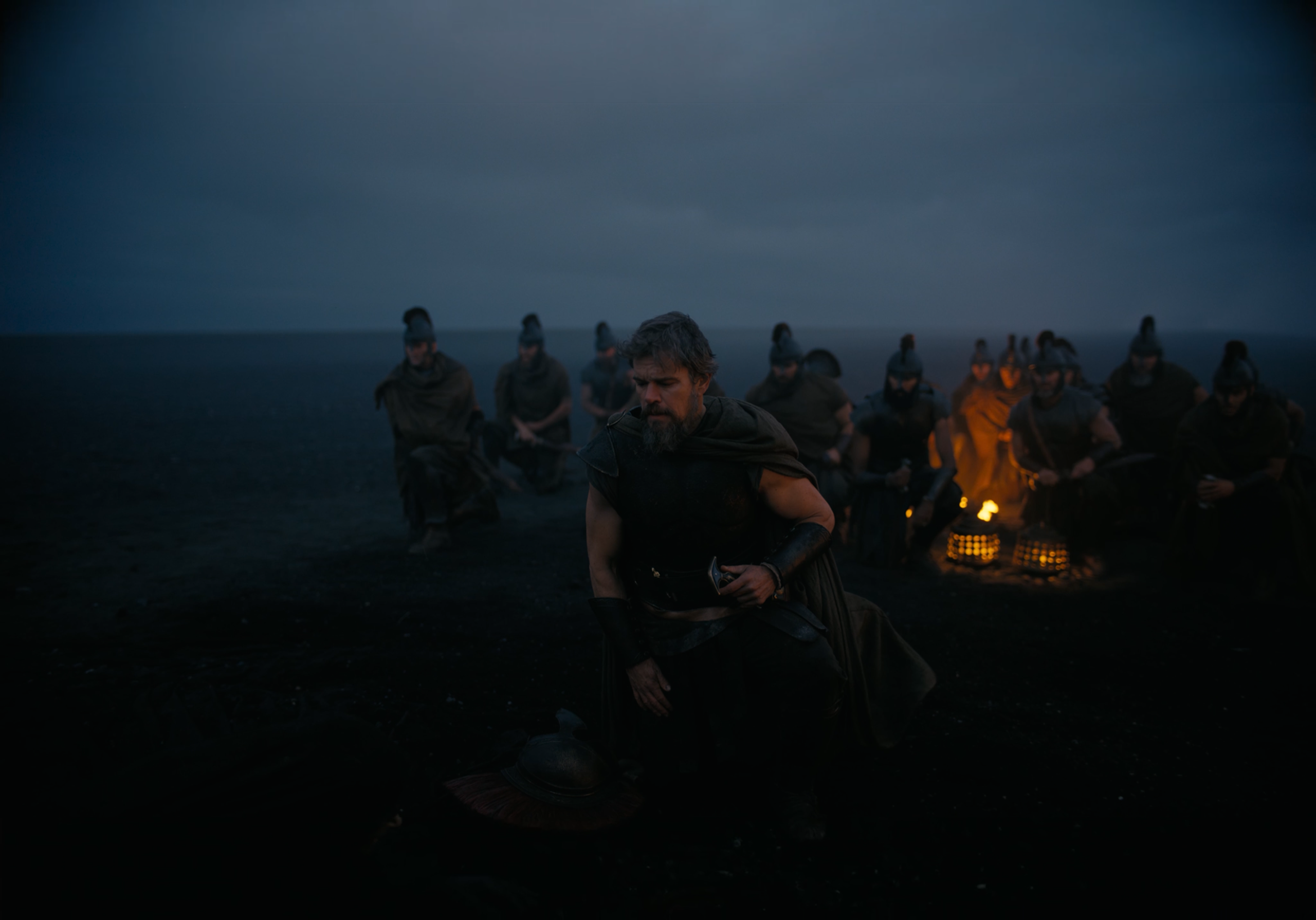
After two decades of experimenting with his famous IMAX cameras, which he cherished so much, Christopher Nolan finally managed to realize his dream: to shoot the first film in the history of cinema entirely with the help of these mastodons of nearly forty kilos, extraordinarily noisy and mechanically unable to shoot for more than three minutes in a row, forcing the actors to regularly interrupt their game the time to recharge the film – when they were not completely obliged to talk to a mirror to see their game partner hidden by the cameras. If one can smile at Mr. Nolan's almost obsessive up-butism, one can only remain ebony in front of the sharpness of these images more immersive than ever, shot only in natural settings: in Greece, Iceland or in the waters of Peloponnese. Even truncated with a certain horizontal portion of their original frame in 1.43:1, Nolan's Scope's Odyssey plans make the part beautiful to a ubiquitous nature, in turn bucolic, arid or raging. Ithaca is green, the land of the dead calcined, and the Mediterranean a flat of blue extending as far as possible. The epic of Ulysses thus becomes palpable and credible from beginning to end, a miracle in a modern Hollywood gangred by the overabundance of often unconvincing digital effects.

Another beautiful quality of the film, the original soundtrack by Ludwig Göransson, composer of Nolan since Tenet, sounds unabated from beginning to end, in a mixture of percussive sounds, traditional choirs, era wind instruments, specially reconstituted for the occasion, and deliciously retro synthesizer arrays.

Ares, when you hold us...

While the decors and costumes were already jasing before the film was released, causing the grunts of the most intransigent Hellenists like that of Nolan's usual detractors, the sometimes anachronistic choices of Nolan are nevertheless perfectly consistent with the spirit of his adaptation and the themes he explores there. His Odyssey makes direct echo ofOppenheimer, staging a wretched Ulysse (Matt Damon, brilliant), gnawed by regret, to the point of considering himself responsible for the late Bronze age (in this case explicitly associated with the « civilization »), because of his disloyal use of the trick that allowed him to emerge victorious from the siege of Troy, thus breaking the fragile bond of trust that still united men.

Hence, we understand better the raison d'être of these rising sandals which, during the siege of Troy, resembles misunderstood rangers, of the shaved skull of Menelaus, camped by a Jon Bernthal accustomed to the roles of bellicose Americans, or even of a contemporary and familiar American language instead of an English whose Shakespeare accents were already imagined. « Ten years on this fucking beach », loose bitterly Ulysses, after an eloquent plan on a row of empty armor aligned like the graves of the American cemetery that adjoins Omaha Beach. The medieval armors of the Lestrygons and the ships of Nordic inspiration of the Greeks are all symbols of warlike cultures scattered here and there, as if to invoke unconsciously in the spectator's mind the spectra of the Templar knights and Viking warriors.

Nolan skillfully uses the Odyssey, this founding story that has passed through the ages, to highlight a bitter reality: two thousand years later, man is still in the grip of his vanity, his violence and his thirst for conquest, without worrying about the consequences he knows very well. Neither the Cyclops, nor Circe, nor Charybde, nor Scylla, nor even Poseidon, contradict the return of Ulysses as much as his own regrets. He hesitates to return to his homeland as his body and mind flow under ten years of traumatic memories, and prefers to simmer in denial with Calypso. Returning to Ithaca as a beggar, he will also appear as a veteran to the suitors – a meaningful word for the Americans.

Ah, are you there, Athena?

The near absence of the divine, which Nolan seems to be rebuking to evoke (the film even opens on an introductory carton it is impossible to be more explicit: « In times appearance Magic » ...), is an extension of the British desire to show that gods, myths and beliefs would ultimately only be a pretext to justify the barbarity of men. The only goddess ever presented on the screen, Athena (performance while holding Zendaya), is deliberately filmed as a mere mortal, without any play of light or staging to distinguish her from Ulysses – who will be the only one to see her.

This bias, moreover, seems to crystallize a significant proportion of the negative criticism received by the film since its first images were revealed. After the huge success of The Dark Knight, almost all of Christopher Nolan's films managed to bring the general public together as film critic. But some indomitable people probably think it would be a good thing to take down every new try of this good Christopher, no matter whether the arguments used for this purpose are well founded or not. In this case, the depreciative attacks on the British's supposed inability to transpose the fantastic to the screen or on his so-called incomprehension of the Odyssey, a text that is so enormously abundant, to the multiple translations and infinite interpretations, are in reality only the expression of the tartuffery and bad faith of a fringe of grinchios unable to accept that a director as popular as he had the nerve to adapt a millennial story in a way that would not suit their expectations. Yet, as Edith Hamilton wrote in his reference book Mythology :

« It may seem strange to say that those same men who created the myths hated the irrational and attached themselves to the real; However, it is true, no matter how fantastic some of these legends are. »

Any resemblance to a certain Anglo-American director would obviously be accidental... Thus, Nolan's Odyssey resonates as a desperate call to show humanity in a rough time, a strident cry magistrally incarnated by the tearing screams of Polyphemus, victim among so many others of the hybris of a lost man, drawn between his desire to return home and the fear of having to confront his conscience.

Devouring twilight films, night literary translator and self-proclaimed specialist of Icelandic cinema, I track feature films at night and day, but especially at night, in order to draw from them the substantial mellow necessary for the survival of the hungry cinemaphile.


5 2 Votes
Evaluation of Article
Subscribe
Notify of
guest
0 Remarks
oldest
most recent Most popular
0
We would like your opinion, please leave a comment.x