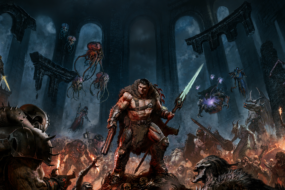

• Tested on PC with a 4K RTX 4070 TI on video projector.
  • Code transmitted by the publisher
  • Played 36h : 16h for the main adventure, the rest for the new game plus and the photo mode.
  • The game will have caught on a few days, sign of the great crus!
  • Home gameplay captures made with the photo mode of the title.
  • This test contains text in Japanese in response to the graphics chart of the game!
  • How do you know?

Out in the middle of the summer, Kunitsu-Gami: Path of the Goddess just got a free update under the sign dOkami, his distant cousin whose he inherits the same taste for Japanese folklore. A kinship claimed at the very moment when the Amaterasu moat announced its return to an unexpected suite of fans. The unlikely marriage between the Tower Defense and the Beat Them All, all sprinkled with a touch of strategy, Kunitsu-Gami has not gone unnoticed for Japanese production lovers. Back on this videoludic UFO that caught us about thirty hours and could well be included in our review of the best games of the year.

An enchanting artistic direction

Announced in band in June 2023 during the Xbox Games Showcase, Kunitsu-Gami seemed to recall universes like that ofOnimusha, cult franchise of Capcom who will soon also be entitled to a new episode after crossing the desert for about twenty years. He whispers that the samurai have the wind in stern since Sekiro and every publisher will soon be entitled to his rereading of the Bushido with all genres. For once, it feels good that it's not in the Souls like field.

Yoshiro, mutic and devout goddess!

Developed by the famous Capcom Division 1 charged with iconic licenses as Resident Evil, Monster Hunter or Devil May Cry, Path Of The Godess has benefited from the expertise of the editor's cadors. Before entering into the heart of the subject, it is not unnecessary to take a step aside to appreciate properly the symbolism and beauty of the artistic direction of Kunitsu-Gami, whose plastic is closely related to Japanese history. Kunitsu-Gami inspired by a secular ceremonial dance, the kagura which means « entertain the gods » in Japanese and where masks occupy a central place. In the game, we'll unlock them after every boss defeated, which will offer us new gameplay possibilities. This kagura rite is taken from shinto or literally « the way of the gods » which can be found in English in Capcom's eponymous title. Shinto (or Shintoism) is a set of animistic beliefs that still deeply permeates Japanese sensitivity. And that's not to say since it has more than 90 million practitioners in Japan today!

The game offers us some pretty prints to deploy its lore.

According to historians, Shintoism could be found at the end of the Jōmon era, which covers the period from 13,000 to 400 years before Jesus Christ. The Kami and the Yōkai, a kind of strikers to enlarge the line, were then venerated until they formed forms of divinities that needed to be appeased. All this folklore is derived from regional oral traditions, themselves derived from the different cultures of the country and certainly morning from influences outside the archipelago following the waves of immigration from China, Korea and the Pacific Islands. These are the same animistic myths that still feed a large part of Japanese culture, whether it be the films of Miyazaki, the disturbed world of mangaka Junji Itō, RPG as Pokemon, Shin Megami Tensei or Dragon Quest, of Beat Them All as Nioh or of horrific titles such as Project Zero and even Silent Hill. You will understand, we could leave this list indefinitely as Shintoism irrigates Japanese works and clearly distinguishes Japanese and Western markets. So how Kunitsu-Gami Is it so different from the above-mentioned games?

Soh opens the way for Yoshiro by drawing the road to the Tori gate at the end of the level
To say that this fireworks effect was captured IRL.

First the development seems to have been human-sized with an original process aimed at marrying the real to the imaginary at the design stage. The teams made models of the villages they then scanned and reproduced in the game. Even the pyrotechnic effects of the swords and lights of articles, one of the signatures of the title, were captured by digital cameras and inserted ingame. A step backwards from an industry too often obsessed with time and the specifications of shareholders doped with performance. Kunitsu-Gami four years of development.

In a video making-off behind the scenes of the game, the developers were able to explain the virtues of the process. As it was a third person game and as the camera is, unlike the games of the genre, relatively distant, it was about maintaining the architectural proportions and probably giving a singular patina to the title. The roofs of the houses were for example made with dried coffee and the pastries that can be offered to Yoshiro were made by a real chef, Masahiko Mizue. No doubt the canteen was good at lunch break! This atypical approach is probably that great Japanese leader who speaks of it best to transcribe the spirit of the development of Path of the Goddess :

« Our goal is to create something new but always in line with the past. I regard this as our duty as confectioners, as artisans. »

Calm before the storm.

Developers then grafted digital elements to organic textures, which certainly contributes to this effect « Dollhouse » which immediately seduced us despite some slender textures in rare places. The photo mode allows you to appreciate the richness of artistic direction and the models of monsters particularly inspired. One guesses that development has had to take a craft direction that has become rare in the video game, outside the indie scene. In addition to these traditional influences, Capcom's Division 1 has appropriated a number of other graphical references borrowed from Berserk, Elden Ring and Devil May Cry on the design of demons in particular.

Each new monster is introduced with its name drawn from the Kami and Yōkai.
The bosses each have their own identity, from a triple visual, sound and playful point of view.

Special mention for the musical composition which knows how to multiply the angles between traditions and modernity by alternating the sustained rhythm of traditional drums with free jazz impulses completely baroque, riffs of guitars endiablés and lunar transitions that one will not forget. Low hat for the very meta score of the latest boss of the new game plus. What a pleasure to see creative freedom left to artistic teams that had already signed the OST of Shinsekai Into The Depts. In the making-off, it feels like Capcom left them blank.

This small team was again able to work on a human scale, recording percussions in the forest with an improvised studio in the middle of the woods. The singer Ermhoi also brings a touch of lyricism to the ensemble with some melancholic flights. The artistic teams have very well integrated the progressive and combative character that operates ingame, since the player desperately fights against time, one of the only dimensions that escapes all mortals, even the powerful, as Coppola recalled very well in his solar utopia Megalopolis.

A polymorphic gameplay

In addition to this question of form, Path of the Goddess So opts by a hybrid anchor between rarely associated genres: Tower Defense and Beat Them All. The gameplay is divided into two distinct parts. The first, by day, aims to explore the levels in the form of villages that will have to be purified in order to harvest violet, simili « currency » local game. Thus, as soon as possible, the bougres caught in cocoons are released, where a dodelinating body like a leg on the crease is guessed. We'd think we'd see remote echoes of the little boy's Limbo scarfing with its own body fagoted in arachnoid secretions very alienesques.

At mid-level Torii doors, one can regain life by performing the kagura correctly.

While our samurai Soh liberates the village, the divine dancer Yoshiro interprets the kagura and advances tirelessly to the gate, goal to be reached and escape of each level. The hour turns and it will not be necessary to stern under penalty of not having enough resources available to plot the heavenly way or to specialize our unfortunate villagers who will defend the beautiful at nightfall. It will sometimes be a dilemma to choose between these two options. Be careful not to move too close to a portal without which the defense will otherwise be more arduous. During this phase, our faithful carpenter (who does not take part in the fighting) repairs traps and other joyous senses to slow down the waves of enemies to come. In addition to the clock that one can make appear to speed up time, we will carefully examine the subtle changes of brightness that announce the twilight and the beginning of hostilities.

Pirouette, peanut... the squid will save your asses more than once!

Once the gong sounds, the second phase begins with the sole goal of defending Yoshiro at all costs. Torii doors appear randomly on the level and hordes of evil spirits will assail us all azimuts until sunrise. It will be necessary to strategically place our villagers around the goddess to protect her. Each of them can be assigned a class whose cost of orb collected during the preparatory phase of purification will depend on the power of the soldier invoked, thus varying from 50 to 300 for the most robust elements.

Onmyojis are the strongest class in the game... as long as we have enough orbs to invoke them.

Atypical for gender, death is not immediately synonymous with failure. If Soh is seriously wounded, his soul will then be materialized into a luminous sphere that we can move on the screen to treat our troops or continue to give them orders. The only priority is to defend Yoshiro under penalty of an insured game over. Our two souls are connected since we are suggested from the earliest cinematics that it is Yoshiro who controls his devoted defenders. Note that cinematics are all in elegance, between natural devotion and a form of poetry of the bizarre and the ephemeral. The narrative, in retreat, operates with little impressionist touches. Muet, Kunitsu-Gami is expressed above all by the non-verbal expressions and festive dances of these troubadours which exorcise the villages of Mount Kafuku.

Some improvements allow us to open safes that make us invincible and more powerful for a brief moment. Reputable to beat our speedrun records.

Last Night with Soh

All the magic lies in the choices made by the player. We can decide to make an army of cheap but limited offensive skills or combine the strengths and weaknesses of each class to win. Sumos are PV bags that attract monsters, while arquebusiers and cantoners keep enemies away with a variable power and fire rate; The shamans can treat the troops, the ascetics slow down the enemies, which will be very useful when one is overwhelmed by the number or against certain bosses speed.

Precious purple orbs escape from the eliminated enemies.

These classes are not all available from the start to preserve the balance of the title. We'll gradually unlock them by recovering dedicated masks after each of the game's many bosses. The general gamedesign of the game also knows how to renew itself to force the player to adapt, without pushing him into his last cuts. This strategic layer remains touched by the first run and it's only by browsing the New Game more than we can really exploit all the gameplay possibilities by switching from defensive configurations to formats that are much more likely to attack our opponents.

Two fingers away from it...

Between the levels, we can appreciate the artistic work done by the teams without the sword of Damocles of time that is pressing ingame. We can then mobilize our troops to rebuild the village, even if possible actions remain very limited. We perform like an automaton by taking these sequences as simple breaths before the night storm. True, in the image of kagura, this gameplay routine is soothing but we would not have been against a little consistency to avoid the redundant effect on the long. You will have to return to each village after completing missions to recover bonuses, a mechanics probably thought for the weaker players.

Indeed, spaming the first level or a boss easy to eliminate, allows to spend time faster while benefiting from precious orbs that will allow us to value our team more seriously with otherwise more expensive units and difficult to reach at the beginning of the game without going through the spam box. For a more balanced experience, we will recommend not to abuse it all the more because the new game plus is a real mirror (in all senses of the term...) of the first run and because it has some peaks of honest but overmountable difficulties.

The « free jazz caterpillar » is one of the funky bosses of the game.

The Art of War

Returning to the villages also allows to recover Musubi who will act as currency exchange with the goddess to improve Soh or the different classes. Once boosted to the maximum, note that their abilities change at all. This is also one of our only grievances against the Capcom game; Some classes are overpowering starting with the onmyoji. After unblocking their ultimate power, the more we've been on our team, the faster we can invoke a demon who, like the well-placed Danmaku shots, instantly allows for Cancel All the enemies of the map. An excessive power that ruined these moments of bravery and fierce resistance where victory was wrestled at the end of the night. Fortunately, onmyojis like spies only appear in the last quarter of the game and they will remain first-rate allies for the new game plus, where enemies are much more numerous and supported by the most powerful units of the game from the first level.

First level of the new game plus... an otherwise more muscular experience!

This is a bit of a pity because this joker reduces the interest of the resistance bars, which have become a common place for recent productions since the success of the soul formula. Indeed, some combos reduce the resistance bar of our opponents and place a powerful blow once the enemy is stunned. A technique that can sometimes cut down several colosses in one special stroke. Soh can also use powers that will recharge after each use and that will be particularly useful to bring down the resistance gauge of bosses. With the onmyojis, this partially breaks this dynamic since it will suffice to wait for the power to recharge (and not long when you have several in the team) to divide by two the resistance line of a boss, thus facilitating the placement of grace shots. There was probably a balance to be found to stem these overly intrusive invocations to date.

Arquebusiers can gain in range once placed on perches. Only limit: we must have repaired them with the talents of our carpenter and be careful that no demon destroys them.
Once the enemy's resistance gauge is low, it's time to put a powerful special blow.

From thread to needle, two additional tsubas are also released, allowing for three locations to launch powerful offensive or support powers. By developing our skill tree, Soh will be able to defend itself at the arch, counter-attack or break the guard of our opponents among other gameplay possibilities. Slight point that can upset in the middle of boss fight, it is not uncommon to visually confuse the invocation with a loaded spell. The invocation of the onmyojis and the lashed blows pass by a simple pressure of the directional cross but their alignment on ropes tied in a shibari way is not always very legible. Besides, a radical artistic choice, the game does not hesitate to display kanjis without translation. It's very nice and it makes the choice of spells very visual without being ergonomic.

Soh combines grace and elegance to eliminate his opponents. The kagura way break dance?

Yoshiro through the mirror

Once the gameplay is tamed and a few onmyojis in the team, the new game more will ship like a letter to the post outside of the last boss exclusive to this fashion and that will have given us a thread to twist. It was also at this time that I really used all the gameplay possibilities by optimizing the placements. Two shamans and four onmyojis immobilized near Yoshiro were taking care of when I repatriated my heavily injured troops and I alone occupied the boss. A technique that has proven itself to ensure the survival of the group while benefiting from the fates of the onmyojis to have openings with this particularly fast, fuzzy and powerful boss. Depending on the player's preferences, you can modify your gaming experience as you like.

Jingle bells revisited...

After the main adventure and the New Game Plus, you can really see the real face of Kunitsu-Gami: Path of the Goddess Speed run! We surprise ourselves to eclipse in a few tens of seconds from the bosses who had given us a lot more trouble in our first game. We optimize travel and approaches to make the most of our team's skills. Brief Kunitsu-Gami offers an unexpected third life that should delight the amateurs of scoring.

Kunitsu-Gami: Path of the Goddess is a game that slices into the Capcom catalogue that continues to assume productions focused on singular and original gameplay, away from the clones of some large American houses that fail inspiration. It will certainly be possible to blame him for a verni of strategy that quickly severs once certain gameplay elements mastered or overexploited but difficult not to succumb to the fun charms of Kunitsu-Gami. Resolutely focused on experimentation, freedom and error learning, the title of Capcom's Division 1 is a full experience and a pleasure of every moment. Driven by an enchanting artistic direction and a concern for detail that forces respect, Kunitsu-Gami has all the cards in hand to push even further his gameplay in the event of a sequel. Hopefully it won't take decades to taste it!
For
  • Super DA
  • Design of demons
  • Craft development
  • A game turned to the player by the gameplay
  • Freedom of approach
  • Customization of villagers
  • Pics of difficulties welcome
  • Boss inspired
  • Discovery of Japanese folklore
  • Elegant and never intrusive cinematics
  • OST fantasy
  • Photo mode funky
  • New Game More essential
  • Evolution of gameplay
Against
  • Disputable balance
  • The superpowerful onmyojis
  • Pretty menus but not always legible
  • Relative gameplay depth
  • Some ugly textures
  • Village reconstruction routine

JV critic and film always ready to lead Interviews at festivals! Amateur of genre films and everything that tends to the strange. Do not hesitate to contact me by consulting my profile.

5 1 voting
Evaluation of Article
Subscribe
Notify of
guest
0 Remarks
oldest
most recent Most popular
Comments on Inline
See all your comments
0
We would like your opinion, please leave a comment.x