- Home
- At a glance
- Video game
- Scorn and the biomechanical ...
- Tested on PC in 4K on video projector somewhere in the middle of the night...
- Game purchased on Steam in Deluxe version with the generous digital artbook (192 pages in English) available for purchase in paper or digital version.
- Adventure finished in 7 hours taking (all) its time.
- The captures of the game were made ingame for the writing of this article.
- The photos of Ron Mueck were taken in Denmark by me during an exhibition on hyperrealism. The artworks are taken from the Kickstarter of the game and from the official artbook. Giger's paintings from the blog Alien Explorations and the Book Taschen that I both highly recommend.
- Folder to read on PC for maximum comfort!
- To go further:
Despite a first attempt by Kickstarter aborted in 2014, Scorn finally managed to win the Grail of financing a few years later. We often tend to reduce Giger to Alien and – ironically today – Scorn Giger. The title proves by the richness of its artistic direction that it is more than just a tribute. Behind the living flesh lies a filiation assumed to a whole part of the history of Art up to biomechanical. You are offered a very personal and non-exhaustive analysis of ten artistic themes that have had to cross the tortured spirit of Serbian developers of Ebb Software.
10 references that cross Scorn
The Space Jokey : Strange comfort to the unknown
Scorn is an example of environmental narratology. With its labyrinthic and mysterious decors, the pleasure comes above all from exploration but not just any. Where the great publishers radiate the screen of indicators, cards and other stimuli to awaken the player, Scorn plays the partition of sobriety and puts everything on its ability to induce a heavy atmosphere by discovery alone. No card and very few contextual indications, the player is deprived of dens and must produce a personal effort to analyze the game and its universe.
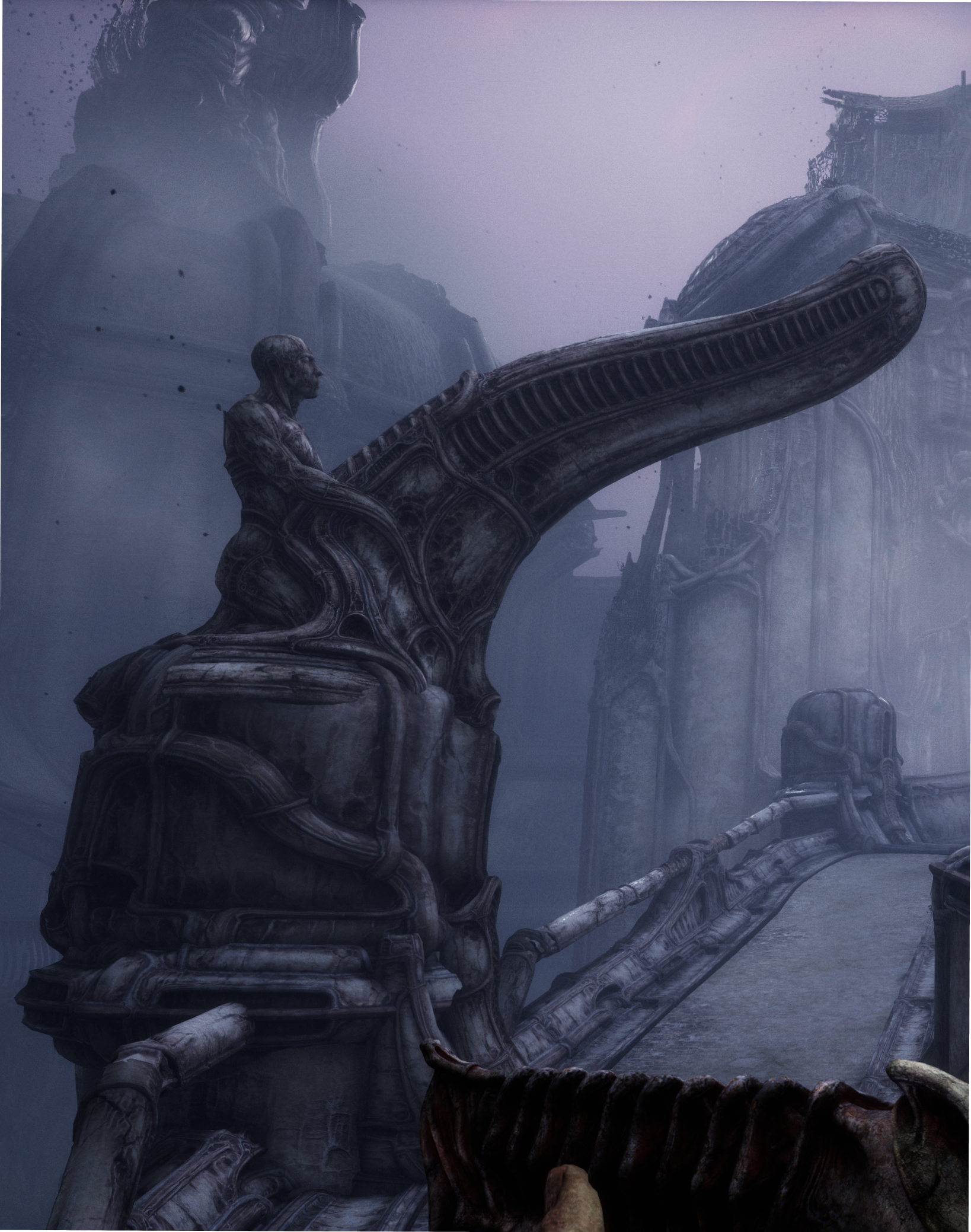
The whole sequence in the lunar desert before arriving in this ship (or this strange station) largely recalls the discovery of the alien wreck ofAlien Ridley Scott. While we wander in this open (and yet closed) environment, Ebb Software has demonstrated an original gamedesign process. As we advance into the fog, strangely familiar elements arise from the mist. We think of moving straight ahead, while in reality we are progressing in spiral. A clever process that makes us forget the invisible walls that surround us. We finally evolve as in a dream where bits appear gradually.
It is thanks to this sequence on the outside and to the illusion of freedom that one feels a strange feeling as one penetrates this construction, both reassured of having found refuge and caution as one swells into the arteries and other corridors that recall sphincters, oesophages and other organic pipes. Very quickly, Scorn reminds us of the Space Jockey dAlien, that life remains present despite the abandoned character of places. It's all the contradiction that goes through Scorn and the work of Giger before him.
The Dead Island of Böcklin and the body awake
If Act I of Scorn know how to drive the player with elegance in his universe, the Final Act is just as brilliant. The majestic arrival in the final sanctuary can only evoke LIsland of the Dead Böcklin, who had already received a tribute from Giger himself. While a kind of car follows a kind of spine rail, a mystical music cuts our breath in front of this breath of fresh air, after having spent the rest of the adventure locked in. The reference to Island of the Dead is obvious, both visually and symbolically.
Left: The Island of the Dead (1886) by Böcklin. Right: comparison Giger (1977) / Act V of Scorn (2022)
Series of five paintings painted between 1880 and 1886, Island of the Dead represents an island at sunset (now dusk in Scorn) to which a frail boat is heading. In the boat, there is a dead man standing, draped with his shroud and looking towards the creek. Here the island has the symbolism of inaccessible like Thomas Moore's Utopia Island. The word utopia also means etymologically « which is not in any place ». In essence, Utopia is a reserved place, withdrawn, which requires an effort from the traveller to achieve it. It is also geographically difficult to reach, protected by the sea and mountain barriers. That's good, Steam's stats tell us that only 30% of the players have arrived here.
While at this stage of adventure one can validly question the state of our hero: death, death-living or resurrected; The arrival in the fifth act looks like an ascent to the Valhalla d'Ebb Software. This death in shroud, it is us, the damned one finally welcomed in the temple of biomechanics where it will totally free ourselves from our own physical body. The opening of Act V manages in a few esoteric minutes to carry the player in a completely different dimension. Ireland Scorn Finally leaves room for light, certainly twilight, but light nonetheless.
Giger biomechanical, dialectic ofEros and Thanatos
It is this fifth act that proposes the most advanced video-ludic vision of Giger's biomechanics. This last level crosses the obsessions of the Swiss artist where death, sex and life intertwine. Here the walls are all decorated with explicitly sexual sculptures. No doubt is allowed while bodies in sifting are engraved in the stone. The pleasure of the flesh was long represented in the history of Art, before it was (among other things) proscribed by Christendom, which favoured the mission of mating dedicated to reproduction alone rather than mere enjoyment. Yet, regardless of continents and beliefs, sex has always been an integral part of man and art.
Giger is only the extension, that of an era in loss of landmarks. Deeply marked by his dreams, very early attracted by sex and death, the artist's work owes much to Freud's influence. Giger is next to the tall, very young mower. Struck with night terrors, fascinated by Death, he who had for fetish a human skull given by his father pharmacist, Giger exorcises his nightmares that he gives birth in painting. By the age of ten, Giger had made his own weapons as nuclear escalation increased with the outbreak of the cold war. In 1975 Giger lost his first love who committed suicide with a gun. Marked alive, the Art of Giger will ssuck, the woman becomes predominant, the sensuality and desire of Death, omnipresent. At Giger, Eros is never far from Thanatos.
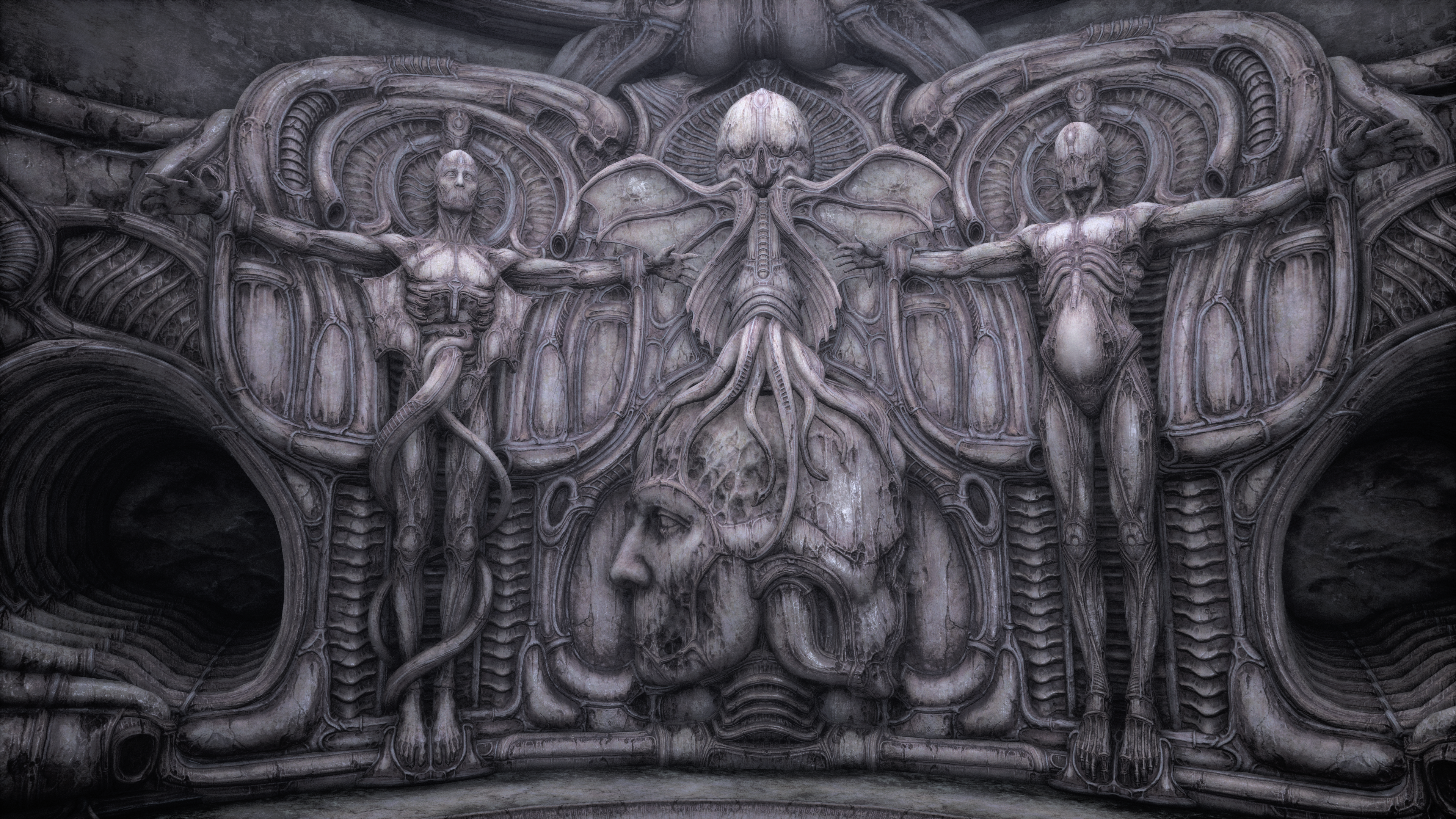
Scorn's act V contains interpretations ofErotomechanics VII (1979) and The Great Beast Totem. Each wall section is not left to chance and confers a mystical character on the whole. Like the Egyptian hieroglyphics from which Giger was already inspired, Scorn In just a few minutes, he can give meaning to his artistic direction. Ebb software manages to register Scorn in his own mythology. Cryptic, the game makes us understand that one has noticed that a tiny part of his universe. In this way, it is our imagination that takes over the author's vision.
While our body is in agony with this creature that is growing deeper and deeper rooted in our flesh, Scorn reminds us that it is only a shell before our final operation. While everything is ready to transplant our body, a da Vinci avatar dissects us methodically. A brief moment suggests a pump to actuate on our genital organ, like a last burst of pleasure tenfold from the engine of Death.
To this, Ebb Software finally adds the symbolism of Life and gestation: several statues and our middle envelope carry a full belly, announcing a "happy event" to come. Many statues are also supplanted by a woman, her legs apart, as in the midst of a rush to expel the baby. It is also the meaning to give to this kind of uterine mucosa that acts as the vault of the sanctuary. It is our death that generates a new form of life in perfect organic osmosis with the environment of Scorn As we will see later.
The frescoes that adorn the walls of Act V are the most obvious tribute to Giger's work. We find a geometric composition that recalls hieroglyphs and biomechanics. The bodies in use are an integral part of architecture. Death, sex and life are everywhere. We find the two prototypes that will later operate, a variation of Cthulhu and fetuses. Everything is connected because in the imagination of Scorn (and from Giger before him), Death and Life are inseparable. In a way, these sculptures are both testimonies of the past and prophecies as our final metamorphosis will demonstrate.
Zdzisław Beksiński and fatality
In the artbook of ScornEbb Software recognizes few direct influences outside Giger and Polish artist Zdzisław Beksiński. Filip Acovic explains how the artist's approach was able to participate in the design of Scorn. « The way he represented his worlds never meant to be realistic [...] but he expresses very well the decomposition and he knows how to be extremely expressive. Everything gets confused and forms become indistinguishable, cracked, hollow, as if they rot slowly in a kind of pattern similar to a spider web ». The Polish artist likely helped Ebb Software to guide their artistic direction.
Filip Acovic continues: « In our own world, the process of organic decomposition first sees muscle matter stiffening after death, then relaxing and finally liquefying. In the worlds of Beksinski, these last two steps do not happen: the liquids coagulate and then calcify, while hardening: the atrophied material does not dissolve but peels and scales in a certain way. »
Contemporary to Giger, Beksinski offers a sinister vision of humanity and one can legitimately think that the recent events of Hiroshima and Nagasaki have largely impregnated and marked the two authors with white iron. When the bombs were dropped on Japan, Beksinski was sixteen, Giger five years old. In Polish artist's paintings, the nightmare seems to have taken precedence over humanity; A fog of ochre ash crosses most of his paintings. The one below, which I have chosen for illustration, presents two bodies intertwined and mummified for eternity like the inhabitants of Pompeii, petrified in positions of daily life.

Without Title (1984) by Zdzisław Beksińsk and personal photo of Embrace (2014) Ron Mueck in Copenhagen at an exhibition on hyperrealism
To complete Filip Acovic, I would add that the character of Scornbetween Beksinski and the master of hyperrealism Ron Mueck, between the rotten flesh and the body full of life. The above painting by Beksiński and its sculptural variation by Ron Mueck are in my opinion the two cardinal points of Scorn until the final stage where the body teares to restore a form of inner peace as the last image left to the player. No wonder Beksinski imbued the work of Ebb Software so much while Life is crystallised in Death.
In His Way Scorn offers his vision of immortality with the harmony found with nature. Like a last delivery where tissues tear to give a new life form. It's all the more remarkable that the last scene takes place after being pulled out of a kind of vagina, carried by our Doppelgänger and always connected by a tissue to this kind of matrix "uterine-euronal. The mutation finally ceases as if the creation had (re)found its finished form.

Comparison between the artwork of the final fresco by Scorn and the ingame version
Körperwelten and the Death of God

The artistic team also draws on another artist who also provoked controversy during his exhibition Körperwelten, where corpses were exhibited in explicit positions of daily life. In my opinion Gunther von Hagens has a place in this retrospective as the artist gives birth to a quasi-heretical approach between shipwrecks of Science and Art.
One of his most controversial works reproduces dead bodies in the midst of a debate. Or how to fit perfectly in the vein of biomechanical. Others play chess, some play sports. This somewhat disturbing artistic approach is echoed in the history of Art, especially with reference to Leonardo De Vinci's anatomical boards. The Flemish doctor André Vesale then freed himself with De Humani corporis Fabrica Libri Septem of academicism of the only aesthetic research for the benefit of Art. New reversal in the representations of Man, the book is a revolution for modern anatomy. It is art that arises in science unless it is the reverse. In the middle of the landscape of hills and ruins, Lécorché took place. Sometimes even dramaturgy is reinforced with attributes that this animated corpse holds.
It can be a shovel as if it dug its own grave. The character of Scorn Isn't he going himself to his own death? There is no doubt that the final scene where a kind of da Vinci's diroid proceeds to our vivisection draws from this hybrid imaginary of art and science. The figure of the skin is also found, as if the essence of man was under the skin, that a complex operation was necessary to reveal its purpose. In my view, the mythology of Scorn This emancipatory transgression owes much to it.
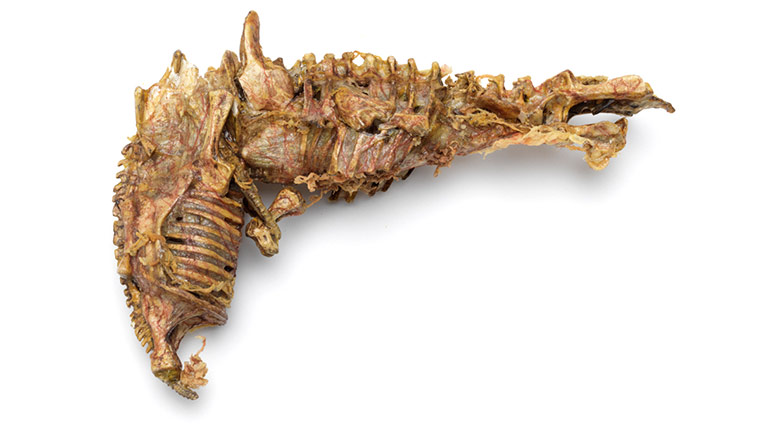
If Gunther von Hagens also has its place, it is by the original process that he uses to mummify his subjects. Plasticization is a technique aimed at preserving biological tissues by replacing different body fluids with silicone. It is during our final operation that our suffering character is released from his bodily fluids by his penis, himself plugged into a pump. If the image is explicit, immortality is gained again by enjoyment. Until the final scene where peace finally seems to be found, after the body was liberated from its original form. Plasticization is also the pledge that there will always remain a trace of humanity for eternity, even though our form will have been dissolved in the hive.
This tear that leads to stage 3 (see previous artwork) is also the result of a painful process. While we entered through a door between two vulva, we are evicted by the same female gate. The body is transformed one last time, deformed, plastic, like a child's fontanelle. Again, Death is the hidden face of Life. Somewhere too, this epilogue only lets us touch the Valhalla before cutting us into pieces. This may symbolize the Death of God and a form of vanity in the search for any spirituality that would distance us from our original nature.
H.G. Welles World War and Organic Colonization
Who travelled through the labyrinthic corridors of Scorn knows how much every wall contains life. The more it progresses in adventure and the more architecture becomes organic not without recalling World War by H.G. Welles and his film adaptation by Spielberg. Just compare the artworks of the game and the images of the film to see the resemblance with this hemoglobin-sung flora that gradually colonizes the environment.
Eventually, the player even sees embryos of enemies still harmless. The walls make up a matrix itself. The metaphor of organic tissue affects the whole range of organs of the human body. There are many structures that sometimes evoke a heart, an esophagus, genitals or a mucous membrane between neurons and uterine tissue. Even though Filip Acovic refutes any filiation with the female uterus as an architectural model, it seems obvious that the female organ has at least unconsciously acted as a landmark.
If in The World War II, the tripods weave links with the humans they raise such as cattle, we find this idea of organic farm with the same model of creature declined at more or less advanced stages of mutation. What is fascinating about the colonization of the world war is that it eventually makes us alien to our own home. The more the flora proliferates, the more the environment and human architecture disappear to give way to danger. This is the paradox of alien films: invaders end up making us foreign to our own country.
The Body Horror from Cronenberg to Tetsuo
The body horror, rehabilitated in recent years by the fantastic cinema and in particular by the sacre of the palm gold Titanium to Cannes, is a subgenre of horror where the body is perpetually subjected to change. In full mutation, our carnal envelope is only a new step before the final metamorphosis. It's just as much the figure of The Fly of Cronenberg that the character of Tetsuo, It's eaten by metal. Scarifications and mutilations become obsession and it is in this sense that the character of Scorn fits perfectly into this filiation. The physical transformation becomes almost religious in the image of Crimes of the Future, the last film of the master of the genre Cronenberg, where we find here also an operation at the crossroads of performance, our hero deprived of any anesthesia.

Comparison between Existenz (1999) and Scorn (2022)
As the parasite that we carry behind our backs like the Dibbuk infects us in Scorn, the rhythm accelerates and our desire evolves towards the need to move towards a new (meta)human horizon where our body would no longer be a burden. If for most of the adventure, it allows us to interact with the environment by opening doors and directly operating systems that we enter, the player suddenly finds himself deprived of this ability in the last chapter, while the parasite has contaminated us almost to the fingertips.
In Jewish and kabbalistic mythology, the Dibbuk is a demon living in the body of an individual to whom he is attached. Cramped on the back of the individual, the Dibbuk would be the soul of a deceased person who penetrates the body of the host living up to corrupt his mind. By the game of the first person and the FPS, the player as well as the person possessed by this Jewish demon never really sees the parasite of Scorn which he will carry behind his back until the painful final operation.
This is when we consult the artworks play or take the trouble of looking at the ground ingame that we only realize how much the parasite takes possession of our primary functions. Even our main weapon that recalls as much the incubating mouth of the alien as the weapon of the alienExist is actually connected to the tail of the parasite. The same applies to our inventory displayed by members who are not always ours. The more adventure progresses and the more one ends up wondering who the parasite or player actually controls the character. This is a classic configuration of the body horror, Like scientist Seth Brundle (Jeff Goldblum) who will gradually yield his free will to the monster of The Fly.
The figure of the cyborg and its avatar Krang
If there is an underexploited theme in ScornIt's probably the cyborgs. When we read the artbook, we realize very quickly that the developers had the ambition to develop this aspect far beyond the final version. One finds a variation of Krang that is positioned in a ventral cavity of a robot before a boss fight (somewhat clumsy).
“These homoncles are made of hallucinogenic matter that people use to achieve higher states of consciousness." explains the producer of Ljubomir Peklar. In the preparatory work of the game, they were expected to be great engineers capable of making robots to compensate for their physical limitations. This aspect of the moment will unfortunately not be exploited for the final game. Filip Acovic simply explains that "Cyborgs are like recycled humans ».
The dead will have been reassigned to these cyborgs "in the same way as humanity recycles plastic." Once it has been reduced to puree and packaged in a receptacle, it will serve as a key (or aersatz of consciousness) to awaken the two sleeping cyborgs who will transfer from one shell to another.
Human condition: from Rodin to Cthulhu
Thought as any other abstract value has long been seen as representing through deities in Greeks, Romans as well as Egyptians. With sculpture The ThinkerRodin overturns this academicism: thought is now embodied by a real man who confronts his destiny by looking before him. Created in 1880 to adorn the eardrum of The Gate of HellThe Thinker was then called the Poet. It is the whole symbolic work of Rodin which suggests both Dante and Rodin, inspired by the poem of Hell. Rodin already represented a being both tortured but free, determined to transcend his own existence through poetry.
In Scorn, We find this symbolism of Man and his relationship to the World. The hero represented during the campaign Kickstarter by the artist Filip Acovic strikes from the outset with his posture. Diving in fetal position, Scorn recalls that hope is now condemned. Lovecraft, author who largely influenced Giger and Scorn Today, Chthullu was first drawn in 1934 in a letter addressed to one of his friends. This monstrous variation probably monkeyed Rodin's while the demon now took the place of Man.
In 2002, Gunther von Hagens represented a man contemplating his inner being. Twenty years later, Scorn At the outset proposes a radically pessimistic vision, as if a complete revolution had literally been carried out since the beginning of consciousness, as a last echo of Divine Comedy and a final warning: « You who enter here, abandon all hope ». We are damned and Ebb Software announced from the beginning the last burst of human decadence. It is in this sense without doubt that Scorn This is perfectly in line with Giger's biomechanics.
The Great Beast, Giger's unfinished work?
To conclude this dossier on the influences of Scorn, I would like to end up with a very personal opening and try to cast a bold hypothesis on the model that could have inspired the parasite of Scorn. Giger's work is infinite so that it also contains unfinished paintings or which could have acted as a sketch for the cinema. One of them The Great Beast immediately caught my attention in my research.
When we read comparative site analysis Alien Explorations, we realize very well that the room with the fuse The Last Ride and outline of The Great Beast have a lot in common. So I would like to believe that the artistic team wanted not only to pay tribute but also to give life to this sketch of Giger. The fear aroused by the player's awareness when he discovered this great parasitic beast immediately recalled this work. In my view, this is the quintessence of the body horror where a few organic elements still betray a human vestige. The shipwreck of Man by the flesh in torment.
JV critic and film always ready to lead Interviews at festivals! Amateur of genre films and everything that tends to the strange. Do not hesitate to contact me by consulting my profile.
Categories
Recent Posts
Raw pearl polished with roguelite : Absolute, the
- 24 April 2026
- 14 min. reading
The Mag.7: a selection for the Myceliads
- 15 April 2026
- 25min. readout
Expressionism in cinema: crises and
- 13 April 2026
- 20min reading
South Park: The Stick of Truth,
- 1 April 2026
- 12 min. reading
The 4K Ultra HD Bazaar, volume
- 30 March 2026
- 52 min reading


Well, I learned things. Thank you for this article!
[...] filming set is a work in itself, like the monumental works of artists like Giger. The plateau is organic and each scene enjoys a nearly pictorial millimetre composition. [...]
[...] planet Giedi Prime des Harkonnens, already the artist of biomechanical (read our file on Scorn and Giger) did not hide his irritation to see his morbid ambition upset: « Evil [...]
great article thanks