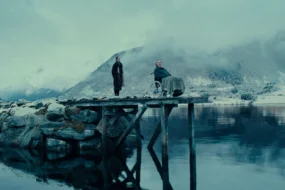
Last feature film by fantasy director Cronenberg after years of absence, Crimes of the Future depicts a society in breathless search for narrative, while progress, supposed to have always guided Man, seems to have reversed all our beliefs. Society has evolved towards a lack of pain and the human body too is adapting to this new environment. Saul Sencer, an artist who has become amiable in surgical performance, gives himself to avant-garde shows where his tumours are extracted in front of an ecstatic audience. Presented at the Cannes Festival, The Crimes of the Futurer (re)enlights the director's flagship themes. Taking the name of one of his first films of 1970 Crimes of the Future is a bridge between the past and the present, as an epiphany of the career of a man who has turned all his work towards the bereaved body.
The desire to be open
With Crimes of the FutureCronenberg again offered a casting of choice. We find Viggo Mortensen in the role of tortured artist Saul Sencer. The actor, friend and faithful of the Canadian director, had already shot with him in History of Violence (2005), The Promises of Darknesse (2007) and A Dangerous Method (2011). Also adding new recruits: French Léa Sédoux (Capress) and Kristen Stewart (Timlin) who signed their first film with David Cronenberg. His two women, who were taken from the performer, cultivated unhealthy competition with Saul. From this trio that will occupy a large place on the screen, arises a magnetic relationship and a heavy sexual ambiguity. Once again worn by an OST composed by Howard Shore, a strange feeling emanates from the first seconds of the film where one discovers a child eating a plastic trash as if it were a four-hour one.
Crimes of the Future explore our « inner beauty » and questions our relationship to Art, from its "gestation" to its consumption. Voluntaryly cryptic and metaphorical in his approach, Cronenberg paints the portrait of a sick society, fascinated by the relationship to the body and its staging during self-harm performances, which became almost obsessive. « What differentiates a tumor from an artistic act ? » questions Welket Bungué, one of the anonymous members of the Murres Brigade, while Saul Sencer and his assistance Caprice translate a joint artistic approach by staging these ablations, even up to tattooing the body from inside.
This is also the author's question. fine during an elegant reflection on the property of the work. Is Saul the one who makes new organs mature in him and testifies to the author's fingerprint? Or should we consider Caprice more as the architect and Saul the material, the sculpture itself, dare we say? It is now a question of listing these bodies. sui generis, especially as Saul seems increasingly prolific. « What if the artist could give life to a circulatory system? » questions one of his followers.
Body is reality
Saul broods each of his creations, which he bore in pain, become a burden. The artist must rest on a bed where organic tubes try to compensate his ordeal by administering products supposed to anticipate his or her moods. Every production costs him something. It is as much a tear as a deliverance. Crimes of the Future Almost put his words into parable. The film itself often takes on performance airs, especially when a dancer sews his eyes and mouth, the body covered with grafted ears in unlikely places. Saul, carpeted in the shadow, watches the show with a curiosity tinted with contempt. The contempt coupled with the assurance of who creates something that comes from the guts.
« The more famous I become, the more one seeks to prevent my desires, even sometimes by shaking the head dubitatively. »
HR Gieger
The dancer's ears do not have an organic function, they are only pastiches of his work can be read on his lips. As the first iteration of a show already seen, this show has no meaning, except that of postmodernity. Saul defends a vision of Art, an essentialist and generator of a new narrative, that of a new stage of Man becoming a completed subject. Saul is the figure of the hermit artist who imposes a form of asceticism to open life to new possibilities. These performances are performed on a curious device that would not deny H.R. Giger, a Sark, a kind of mechanical shell formerly dedicated to autopsyes and now fetishized by the performers' followers. Here we recognize the symbiotic aesthetic between flesh and metal, where the living is confused in the artificial and vice versa. A subject dear to the Swiss artist at the origin of the most famous film biomorph: I-Alien.
Surgery is the new sex
In this dystopic world that might as well take place in the past or near future, the quest for transgression must find new borders to be overcome. « When I saw Caprice incise you, I wanted... I wanted you to incise. » brazenly surrender Timlin in Saul, at the end of his show and in front of his assistant. « Surgery is the new sex » is repeatedly scanned as a revelation of an era in search of overcoming and new challenges to be met. Crimes of the Future maintains constant erotic pressure with an acute sense of staging and photography.
As Saul produces organs, the rhythm accelerates and his desire evolves towards the need to move towards a new human horizon, as a distant echo of the transhumanistic fevers of our time aimed at conjuring death. It is as if the disappearance of physical pain would bring man back to the memory of a distant golden age whose memory he would cultivate by permanent scarification. Far from being freed after the pain faints, it is infinitely possible that seems to offer to the human condition. After all, in psychiatry, is the act of scarification not a means of resisting the psychic pain that has become insurmountable by replacing it with acute but controllable physical pain? A parallel that one can as well draw with regard to sexuality 2.0 that underpins the practices of Caprice and Saul.
One ban hunting another
Each of the encounters between Timlin and Saul is electric as much as it constitutes a coitus impasse proper to the « Former sex ». Every step forward from Timlin, Saul step back. It's like our consumerist and hypersexualized society has lost its rudder. Saul is the prophet of a new era, from one relation to the other maintained by inverse roles of the incised and surgeon. « The desire to be open » Kristen's or that of leading the show by Léa Sédoux reveal a deep desire to create something resolutely new from the void. Timlin dreams instead of Caprice and we can read many transfers between the two women. « I felt the desire to get my face opened. » Finally claims Caprice, after implanting prosthetics under the forehead.
Surgical shows recall the mystical voyeurism ofEyes Wide Shut (1999), This time the cameras would have replaced the modesty of the masks. Crimes of the Future cultivates something timeless as evidenced by the variety of catch devices used by the public in front of Caprice as the mistress of ceremonies. An initiatory rite, like a transition from one humanity to another. From the disposable device to the camcorder, there is a strange anachronistic distance that settles in and, curiously, lets us see the exhibitionist side of our time. Even the decors, relatively discreet, could testify to an apocalyptic universe as well as a neighborhood underground of Naples or Athens.
Crimes of the Future is very contemporary in the themes he addresses. In recent years, we have not seen new entertainment creatures proliferating whose entire lives are now dedicated to their transformation to another body, like Anthony Loffredo, who becomes a little more his avatar every day. Black Alien ? Amputations of the nose, lips and fingers, artificial spine transplant, full tattoo... so many operations dedicated to followers which question the underlying approach. Who of the Art or the Hydra of Capital dictates each of its transformations? In Cronenberg's film, it is also the issue raised by the Murder Brigade and its apostles who see in Saul's worship a Humanity in perdition. Unless it is a matter of reinvigorating politics in an artistic approach too often deprived of essence?
« Crimes of the future evoke the crimes that the human body inflicts on itself. Art is not necessarily prophetic but we can anticipate certain things, a little by chance, especially when we write science fiction. And that is the case with this film. »
David Cronenberg
SAre we struck by obsolescence? ? » Question Caprice. This replica reflects the fear of an era, that of being transformed into a product by a large market that has stopped extending its sphere of influence to our most intimate space. For the director at productions on the margins of the blockbusters traditional, it is as much Hollywood or the giant Disney that gangrene the artistic creation of new standards and specifications aseptized. This is also the question of the work and the Artist when perhaps everything has already been said by others.
« Autopsia means seeing for oneself » explains Caprice, while the couple is about to perform an illegal performance involving the autopsy of a child killed in his sleep by his own mother. If the end is a little abrupt and some scenes sometimes artificial, Crimes of the Future Nevertheless, it remains a radical proposition, mirror of Cronenberg's work. If the script dates back to 1996, it is not forbidden to imagine that the confinement imposed on the entire planet had an impact on the project's genesis. From his photograph to the cold tones, which blends perfectly with the precision of the scalpel to the themes discussed, Crimes of the Future to see better outside.
A singular artist in the film landscape, Cronenberg signs a new personal play that does not leave indifferent. Cronenberg, who had already refused to carry out more consensual projects such as Top Gun or The Return of the JediHere, trace its own path with the constancy of a metronome. As in Chromosoma 3 (1979), Videodrome (1989) or more recently Titanium (2021), Crimes of the Future is a new stage in the very closed club of body horror.
Movie trailer
Behind the scenes of the shooting
JV critic and film always ready to lead Interviews at festivals! Amateur of genre films and everything that tends to the strange. Do not hesitate to contact me by consulting my profile.
Categories
Recent Posts
Le grimoire de bord du 33e Festival
- 5 February 2026
- 52 min reading
The Dark Rites of Arkham, pulp &
- 3 February 2026
- 4 min. of reading
Neil Marshall, downhill to Gérardmer
- 1 February 2026
- 2min. of reading
The 4K Ultra HD Bazaar, volume
- 26 January 2026
- 56 min. of reading
Avatar, the living (digital) who defends himself?
- 22 January 2026
- 13min. reading


[...] all the rakes, Perpetrator claims his relationship with the horror body and naturally Cronenberg, which he never manages to [...]
[...] the spectator in breath. Less experimental than his latest film Les Crimes du Futur (read our review), Les Shrouds is more sobriety. Fans of the director risk suffering from [...]