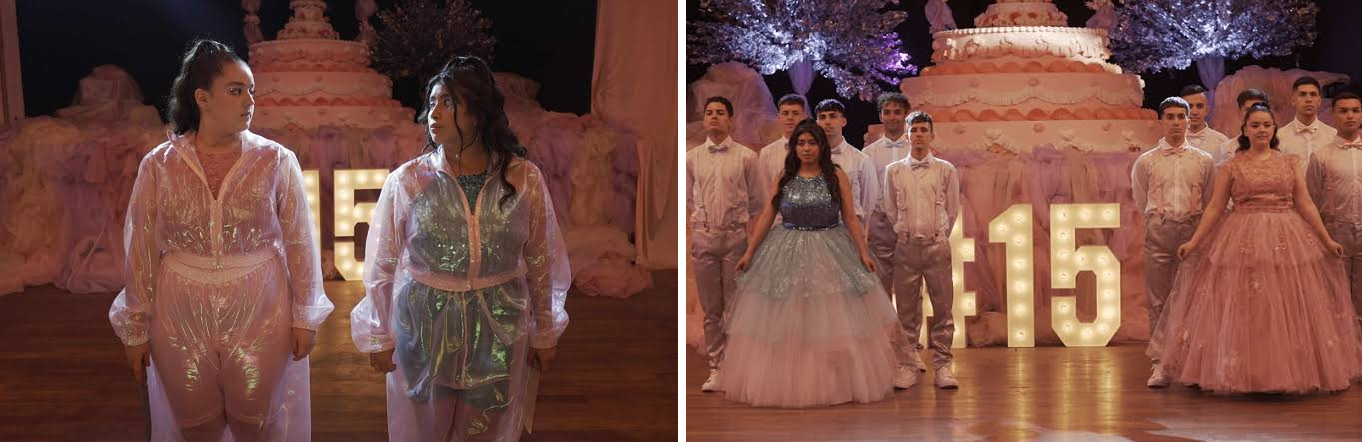
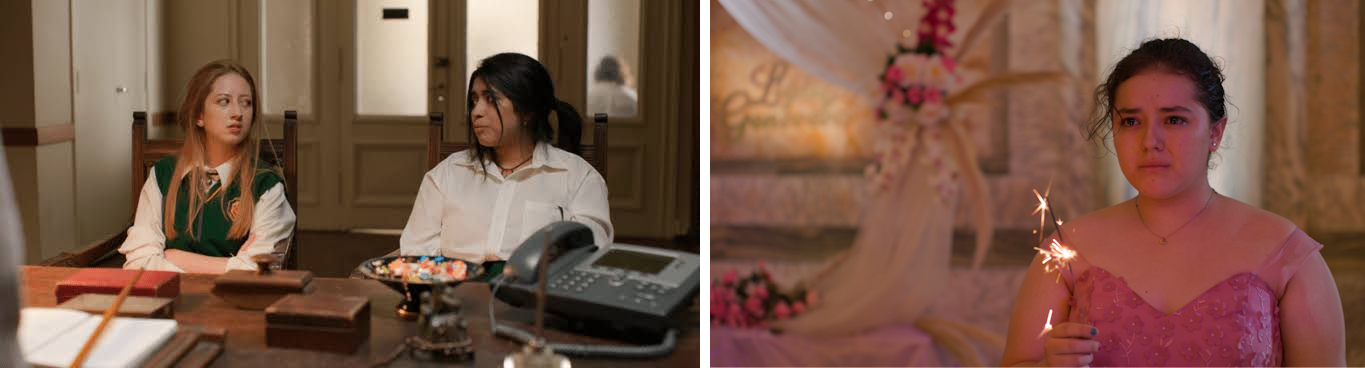
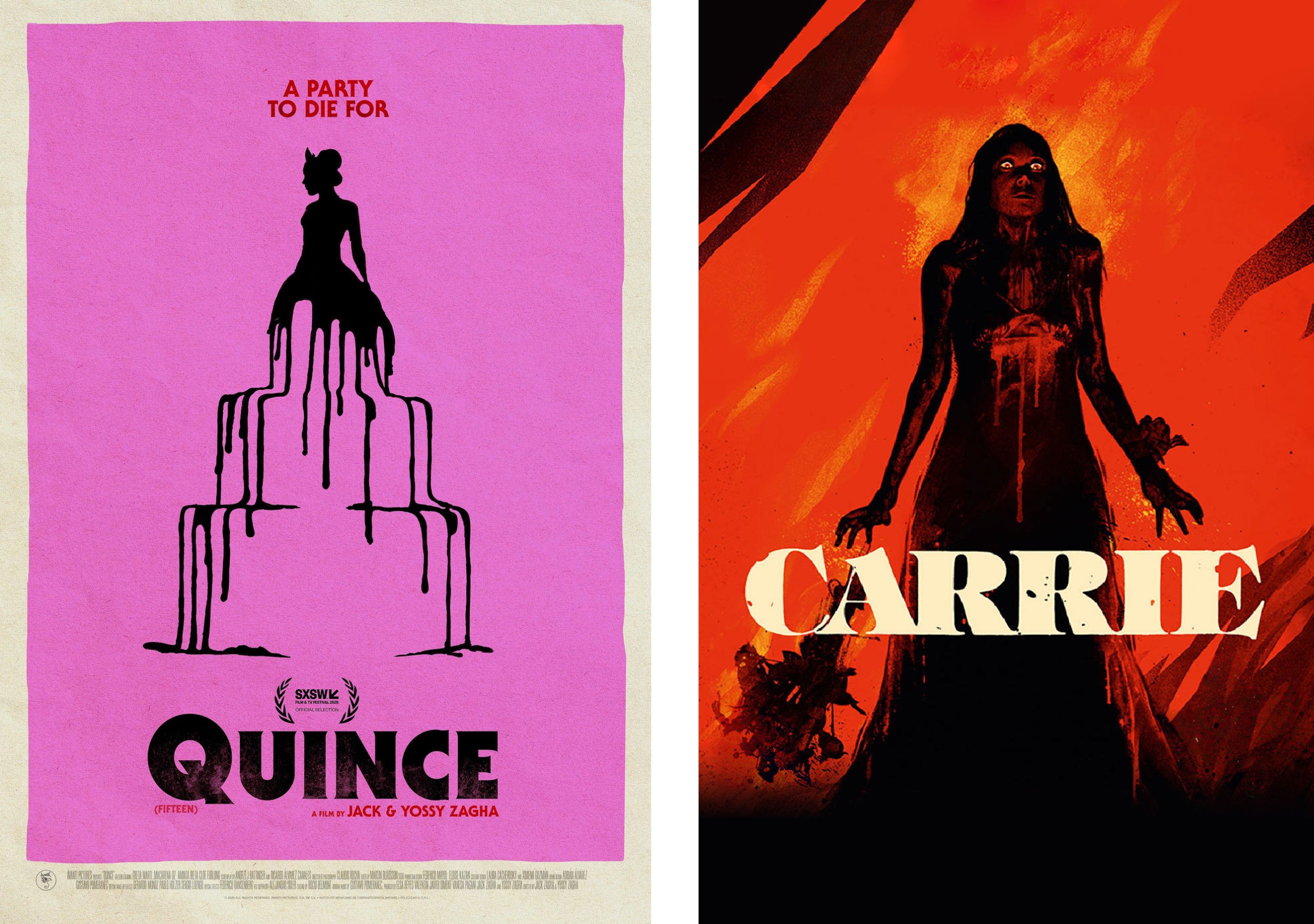
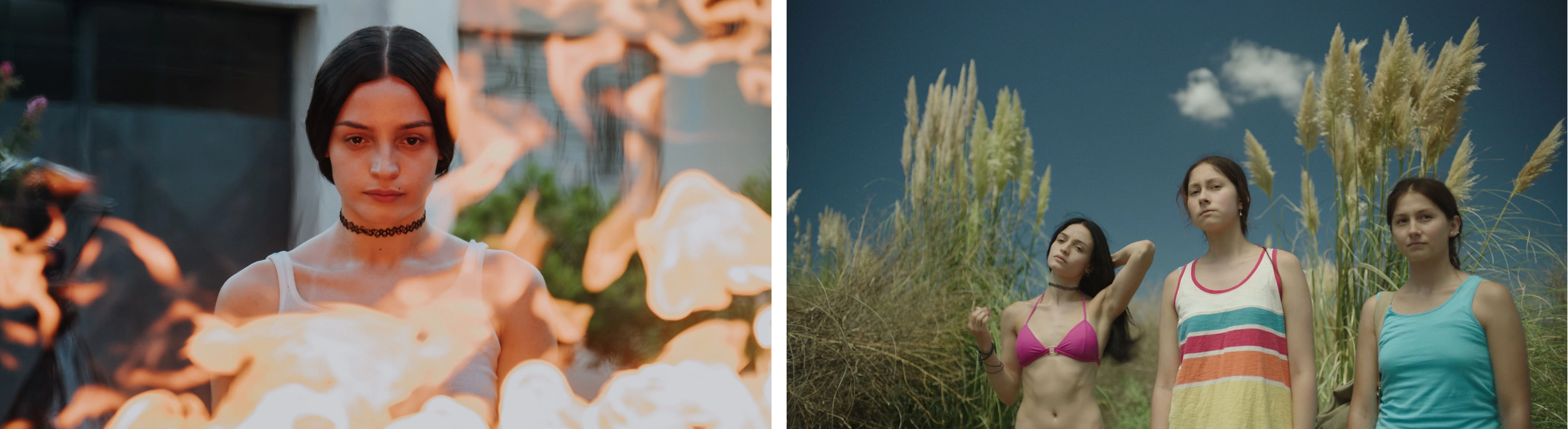
In Latin America and especially Mexico, Quinceañera is a popular celebration of the transition to adulthood of girls. In this coming of age at the crossroads of telenovelas and a failed B series, two inseparable friends see their friendship put to the test, while one of the two falls pregnant by a supernatural creature. Despite some rather successful tone breaks on the first half of the film, Quince switch to the reac film with a stinking message. Like a foretaste of Bollorean cinema waiting for us, Quince Almost could have found its place in a fundamentalist Catholic festival dedicated to gender.
15 shades of patriarchy
For this European premiere at the Neuchâtel festival, filmmaker Jack Zagha Kababie came in person to present the session. Before starting the screening, the Mexican director split an explanation of the importance of this initiatory transition to adulthood for Mexican girls. A detail that takes on its full importance since the plot of the film rests on this untenable expectation of teenage girls from a private school for girls. Administered with an iron hand by a Catholic principal, the establishment obviously promotes a traditional vision where pre-marital sex is a formal prohibition that cannot be carried out. Young virgins are filled with dreams of princesses, maintained by social networks where thehashtag quinceañera is an indisputable. Having a viral quinceañera is Ligie and Mayte's dream, both of which come from precarious environments.
The two girls form a team united against Genoveva, an archetype of the bourgeois girl with a slapped head, who allows herself all the cracks against her comrades. The little plague must be at the center of all attentions and she expects that her quinceañera is unforgettable. On this point, the film rather succeeds in showing the social fractures of this ritual where some privileged families do not hesitate to spend sometimes up to more than one million Mexican pesos, or tens of thousands of euros, when other young girls will have to work hard to buy a party to the height of their hope. Mocking for their proximity, Ligie and Mayte are suspected of being lesbian. But this ambiguity will never really be one, since the filmmaker will not go further on this point.
Coming of age doubtful
Quinceañera is like a marriage but just for yourself. Traditional festival par excellence, this prenup protocol is very framed. The Mass often occupies a central place, the change of symbolic shoes recalls the fairy tale of Cinderella and the unmissable prince charming to come. It is also the father who dances a last waltz with his daughter before the assembly. Sometimes we offer a very last doll, symbol of the end of childhood. If Quince does not necessarily show these rites, it is because it focuses above all on the months preceding the Quinceañera and where the girls prepare with diligence the event as if it were a marriage.
To this patriarchal and retrograde dimension of Latin American societies preparing girls to become good wives, the quinceañera has in part evolved over time and customs. For part of Latin youth, the festival subverted this grotesque prenupial parade, even serving political dimensions. In the most progressive families, quinceañera can thus become the occasion of a coming-out, feminist demands or queer, contrasting largely with the original archaic version. This duality does not appear in the film by Jack Zagha Kababie and Yossy Zagha, who decide to target traditional Mexican society. Quince flirts for a long time between the registers, even if to unravel its spectator, who comes to wonder about the message sought by his director.
You won't get away.
When Ligie gets pregnant, she goes with her friend to the hospital where a doctor (represented in a fine day) refuses her abortion where he is still penalized in more than half of the Mexican states. So it's in a suspicious underground clinic that Ligie's gonna have to go to get an abortion. Then the malaise settles when the gynaecologist caresses insistently the girl's intertwine, despite the presence of an assistant in the operating room. Ligie then kicks three times in the instrument cart, before the wicked perverted doctor rumbles her, because she does not want to abort. Contrarily, Ligie then eliminates the entire firm, then reconnecting with the B series with very small budget for the best and especially for the worst.
If there was still doubt about the reactionary nature of the scene, the epilogue no longer leaves any doubt about the « vision » of the Quince, decidedly Carrie par excellence. The quinceañera of the petty bourgeois then turns to a massurder with a glubiboulga of completely failed murders. The golden rule when you have a small budget is to play with the economy spectacular scenes. Avoid dark light and prefer darkness and tight planes. Quince proudly displays its mediocrity by multiplying the long planes where one even sees the shadows of the projectors. The gaffes are so big, it's been asked how this could have gone through the assembly. Whether it's the dead grandmother who blinks twice with eyes or with kids who turn on dead cigarettes, the blood flowing like clear water, the cameraman appeared to check all the boxes of amateurism.
The heterocentric female desire
However, a whole section of the cinema of the 1980s has shown that falsified film does not necessarily rhyme with screwed film. In addition to the two young girls and sometimes successful tone breaks, Quince multiplies all the clichés of the wrong genre film, with the eternal text explanation and the unmissable search Wikipedia of demonic folklore and other joyous to seek a meaning intrigue. We laughed more than once in front of certain scenes punctuated with guitar riffs that seek both well and hard to amplify the dramatic effect. Where Quince Could have become a nice nanar, we came out seduced by this crude image aimed at denouncing abortion under cover of friendship. Instead of giving us a shocking soap movie, Quince Could have shown the contradictions of Mexican society between the two sides of the quinceañera. Worse still, the masculine look here forbids really displaying the desires of young girls.
Yet other films have not hesitated to show in a very frontal way what goes through young teens in a hurry to discover sex. That's what the great thing was doing Virgen de la Tosquera by the Argentine director Laura Casabe. A cynical and icy film that we were talking about at Fantasia last year. We still remember that teenage girl going to see a prostituted man to lose her virginity. To the antipodes of the modernity of Casabe's film, Quince will approach female desire only in the tone of the joke, as if only the dream of princess had a vocation to exist only through male libido. Following this European premiere, let's promise that Sage would be found everything to distribute the film in France... Yes, we saw a Mexican prolife film in Neuchâtel and we still wonder how it was selected at the NIFFF. A session all the more embarrassing as the director was with us during this shipwreck. If a captain never left his ship, we would have liked to escape from this sick session.
JV critic and film always ready to lead Interviews at festivals! Amateur of genre films and everything that tends to the strange. Do not hesitate to contact me by consulting my profile.
Categories
Recent Posts
Harmony Korine, a cinema for those who
- 20 August 2026
- 13min. reading
Suddenly, the lesson of materialism applied to the
- 19 August 2026
- 15 min reading
Fjord, defining violence: cultural impasse?
- 18 August 2026
- 26min reading
Heave Ho 2, being a trunk man, that's
- 10 August 2026
- 10min. reading
Colossal, the kaijū reinvented to the feminine
- 10 August 2026
- 8min reading


Let's make it our worst session of this NIFFF 2026! Thanks for the review
On X, @PinkUnicorn42 seems to disagree with your feeling: "Wut? But for me it's against this Catholic moral? It denounces him and shows the oppression that she makes young women suffer." A response from you would probably make her heart warm. 😉