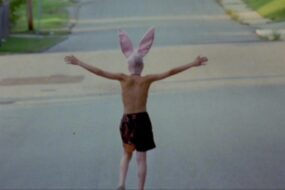
A documentary, again. An out-of-standard movie again. Submitted to Real Visions, the feature film of Alberto Martín Menacho We're about to get out of the room. Prepare for a dive into deep Spain, dumped between electro waves and millennial hunting, drone buzzing and centuries-old breeding traditions. What is the youth of a futureless country torn between two antinomic polarities? That's the question this big-gauge movie tries to probe, building a bridge between once and tomorrow...
Incompatible desires
Night before yesterday, "Antier Noche", an expression that falls into disuse yet worn in frontispiece of a film that tries to make ends meet: the life before – about to disappear, flickering, threatened? – and the one after – ever more present, overwhelming, invasive while offering not the slightest prospect of the future. And to represent this "Night of a World" approaching, the director makes the bet to give away a handful of young people and their entourage. Sticking them to the Basques, to work, to home, to friends or to friends, from the most complicated awakening to the wedding that tears a night that one hopes perpetual... A choral portrait brushing the contours of a territory without maps, with as the only landmarks the impulses of a youth that is completely impoverished.
The director Alberto Martín Menacho chooses for setting an Iberian village never named, hardly described, in which As bestas Could have been turned. Confetti d'une ruralité en crise, lost in Extremadura, one of the poorest regions of Spain, where young people find their future only in elsewhere. But if the film Sorogoyen Could have been an obvious reference, the true fictional duration of the documentary that we are interested in today would rather be looking at the magnificent El Agua released last year. The same themes, the same territory, even the intriguable youth, the works dialogue and complement each other to create together the contours of a sociological outline of a country in crisis.
Docu-mentor?
In Anti-noise, the process surprises. We are sold a documentary, yet the foreground (the only camera side of the entire feature) reveals behind the scenes of the casting for the film we are about to discover. Quite strange for a feature film that prides itself on the documentary stamp? Not so sure! What is certain is that from the outset the director sets the tone: Anti-noise Will skillfully knit his speech by mixing in the documentary frame of the sons of pure fiction.
On filming, Alberto Martín Menacho On the landscapes of this remote region with a large majority of fixed cameras, sometimes offering long circular panoramas embracing the horizon, sometimes close-ups on gestures that seem to fascinate the director as much as they know how to captivate the viewer. And these focus allows to detail the ancestral manual knowledge (the axe extracting cork, the knife cutting meat, the teenager keeping his animals, etc.), while making them communicate in the plan with elements of extreme modernity... The smartphone illuminates a face, the phone ringing shaking the quietness of a motionless campaign, the buzzing of a drone disturbing the quietness of an undergrowth.
These gaps of modernity are incarnate on the screen as threats to a world that has already been lost. If a grandmother tries to explain to her granddaughter how dangerous the city can be or means disappointment, one understands in the timid acquiescences of the young woman that there is more here to keep her from leaving.
Cork caps and class struggle
One of the most striking scenes ofAnti-noise takes place in a cork oak plantation during harvest. For a long time, the camera is trying to detail the pressed gestures of these sweat-dipping harvesters, handling their axe with dexterity to start the bark. The blade slices, simmering, takes off the cork from the wood, until an expert hand manages to untie a roll that will soon weigh the back of the mule waiting for its cargo.
Then the sun calms down, the trunks impudently expose their undressed curves of their cork laces, and two harvesters discuss in the shadow of the subera of their future. The conversation slides: how much is it worth, what they just got out of the sweat of their foreheads? And how is it that they break their backs for a wage of misery, while cork will eventually be sold at a price of gold? And finally, what would happen if they, the harvesters, refused to continue to be enslaved?
A speech that swells several times in the feature film, especially when an employee gets fired from her seasonal job with the thanks of the boss who is looking forward to being able to work with her again next year (understand, as soon as she is again useful). In short, the campaign seems to have become the ideal place of sowry where the filthy paws of capitalism come to use in so-called unqualified labour, rejecting them, exsanguing and underpaid when the yield comes to dry.
If, as in the case of the speech of cork harvesters, there is no evidence of the word, the camera of Alberto Martín Menacho tries to retransmit these gestures, these practices, these traditions. The opportunity to show – in addition to their cinegénie – that the notion of "unqualified profession" only makes sense in the mouth of office pianotenders, manipulating their employees-bevelling through the interface of an anonymized spreadsheet. People become numbers, the matrix becomes impermeable, traditions die, youth stifles. At least is there a sign of hope, a glimmer of optimism under the director's camera...
Rave, mule and botany
By avoiding quite brilliantly any pastism, just as much as a veneration of principle – bliss and reac Better, if he exposes without brows the many threats surrounding these remote and rural territories, he does not do anything aboutAnti-noise a miserabilistic pamphlet but breathes into its last segment a message of hope passing – obviously – through youth, love, party and a stubborn summer night that lulls us with illusions and delusions. beats Electronics...
A rather impressive feature film, especially since it is the first of its director, Anti-noise Come out on March 21!
Drinking the Stephen Kings as the apricot syrup of my native country, I first discovered cinema through its (often bad) adaptations. I'm married to Mrs. Wilkes as much as a persistent Stockholm syndrome, I am gradually opening up to videoclub films and B-series peasers.Today, I wander between my favorite cinemas, film festivals and the edges of Helvetic lakes much less calm than they look.

Categories
Recent Posts
South Park: The Stick of Truth,
- 1 April 2026
- 12 min. reading
The 4K Ultra HD Bazaar, volume
- 30 March 2026
- 52 min reading
Allah is not obliged, the snare of
- 25 March 2026
- 2min. of reading
The Testament of Ann Lee, of Fornication
- 24 March 2026
- 6min. reading
The Price War with Ana Girardot
- 23 March 2026
- 1min reading


It is the spring of documentaries. That sounds really nice again. I need 48-hour days. I love integrating litho into the article.