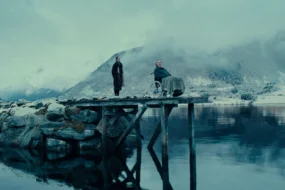
« Today, Mom died. Or maybe yesterday, I don't know. I received a telegram from the asylum: “Dead mother. Bury tomorrow. Distinguished feelings.” That doesn't mean anything. Maybe it was yesterday. » The first lines of Foreigner (1942) immediately define the character of Meursault, an elusive character, marked by a certain indifference to his time and destiny. Difficult exercise, adaptation can quickly turn into a trap. How to transcribe the fulgurances of a spirit crossed by the absurd?
Interview with François Ozon
The absolute end of the world
Meursault is indecipherable for his pairs but the reader enjoys an additional reading grid. The absurd result is narration. If the form of the first person is used to show the interiority of the « I », Foreign, the work of Camus's absurd cycle, plays on dialectics. On the one hand, man is alien to the world; on the other hand, Meursault is alien to himself. So how do I seize someone who doesn't understand? As Jean-Paul Sartre wrote in his Explanation of Foreigner (1943) :
« Foreign [...] plunges us without comment into the "climate" of the absurd ; The test then comes that illuminates the landscape. But the absurd is divorce, the lag. The foreigner will therefore be a novel of mismatch, divorce, change of scenery. »
Jean-Paul Sartre, Explanation of the Foreigner (1943)
The most absolute of all, that of a man who kills an Arab because of the sun, the one whose gestures seem indecipherable to his most intimate entourage, is the very substance of the Camusian work. Problem, François Ozon largely deprives himself of the inner comments of the character of the novel. In the latter, Meursault is sometimes disillusioned, sometimes indifferent, as if the « I » He sought to externalize himself; in the film he was the archetype of the phlegmatic character, without having access, even for a moment, to this inner paradox. The gestures are seen, without access to the origin of the gesture. Deprived of the narrator's disillusioned comments, Meursault d的Ozon is mechanically more generic.
As Sartre still wrote, Meursault is like the man who calls in a cabin: one can see his gestures, but one cannot listen to him. This « abrupt communion of two men, author and reader, in the absurd, beyond the reasons » escaping François Ozon, who seeks to color the context of Meursault's actions of an ideology closer to our contemporary era than to the colonial climate of the Ager of the Interwar era. « It wasn't about making a film like it would have been made in 1942 when it was released but with a hindrance on the history of France and Algeria. » recognised François Ozon during our exchange in Strasbourg, ahead of the release of the film.
Visibility of the invisible
In the footsteps of writer Kamel Daoud and his book, Meursault: counter-investigation, the filmmaker also decided to name the victim of Meursault, where Camus made her an anonymous, simply evoked by her ethnic origin. In the novel, « Arab » is not subject, it is the object of the plot. He was killed by Meursault but, apart from being a victim, he would not be more interested, nor even in his profile. This reinforces the symbolism of the absurd: the commission of a crime without motive, if not a crime motivated by the indifference of existence: his, like that of « Arab », whatever the consequences of the gesture.
The fruit of a dialectic that limits to the absurd, Meursault is not suicidal, even if he goes to meet Death. In the last lines of Foreignsentenced to capital punishment, « criminal in spite of him » seems for the first time to express a sincere desire: to destroy. Meursault opens to « the tender indifference of the world ». The concordance of the times chosen by Camus reinforces the absurd feeling of the marriage of time of the signifier to the contrary modalities. « I felt that I had been happy, and that I was still » This is the terminal illustration.
This is evident from the choice of the most-perfect, a sign of an action completed and prior to another past action (« I had been happy ») that Camus articulates with the imperfect characteristic of an action of the past but resolutely unfinished (« I was still »). This lapidary sentence materializes in itself the timeless character, signature of the singular narration of Foreign. The modalities of the verb's time are systematically countered. Meursault is and is not at the same time. The author continues:
« For everything to be consumed, for me to feel less alone, I had to hope that there would be a lot of spectators on the day of my execution and that they would welcome me with shouts of hatred. »
Albert Camus, The Foreigner (1942)
More clumsy, the love relationship with Mary (Rebecca Marder) comes in line with Ozon's adapted narrative. One guesses the temptation to layer modernity on the past, making Mary an emancipated character. This is the meaning to give to this scene of the film, where the young woman, educted – but lucid – affirms her indignation at Meursault, who did not brow when her neighbor beat his wife. François Ozon explains what should have been silenced. In addition, the director falls into the same pitfall, when he seeks to unravel the elusive desire that unites Marie and Meursault. Yet morality is orthogonal to the absurd, which is more in the context of writing the original work.
Interview with Benjamin Voisin & Rebecca Marder
« She wanted to know if I loved him. I replied... that it didn't mean anything, but that I probably didn't like him. »
Albert Camus, The Foreigner (1942)
The more important place given to Marie in the film upsets the Camusian focus, bringing Meursault closer to Bartleby. Marrying Mary or not is equal to her: « I would prefer not to ». But this indifference is not the same, Meursault is the product of a thought. « limited, deadly and revolted », where the character of Melville responds to another form of absurdity; It's not « a will of nothing » as Deleuze writes, but the « nothing of will ». Meursault, on the other hand, is the root of the world's bustle, he confronts destiny through his actions; Bartleby, lonely, resists by flight.
François Ozon unconsciously or unconsciously renounces one of the two hemispheres of the narrative of the work, even if he follows the chronology and dialogues to the letter. « Foreigner is not a book that explains: absurd man does not explain, he describes; It's not either a book that proves » accurately wrote Jean-Paul Sartre. Even minimal, this contemporary temptation to explain the text questions: was it a question of proposing an attempt to absolution by this adaptation? Moreover, Foreign Is he really transposable to the image without betraying his character?
« A phrase from the foreigner is an island. »
Jean-Paul Sartre, Explanation of the Foreigner (1943)
The dialogues of the novel are inseparable from the intra-diegetic narrative. The alchemy of the verb also loses its superb. Read Foreign produces the sensation of a suspended moment, where each event is a non-event. The Camus style marries the opposite: « The pronounced phrases appear as events similar to others, mirror for a moment and disappear, like a flash of heat, like a sound, like a smell » Add Sartre. Perhaps overwhelmed by the original desire to make a film with Benjamin Voisin about a man unsuitable for today's world, as he told us during our exchange, did François Ozon miss the ambiguous sense of the Camusian work?
Meursault is certainly an inappropriate character (for an inadaptable work?); That said, it embodies the lowest common denominator of revolt. Despite a sincere note of intent and the actors involved in their roles, we will rather read the novel again rather than see a film ankylosed by the weight of our time, as if the novel categorically refused any reappropriation.
François Ozon, director
François Ozon, born in 1967 in Paris, is a French director, screenwriter and producer known for his films that often deal with topics such as sexuality and affirmation of social norms. He is often appointed to the Caesars (six times) without having won, but received the Light of the best staging (2003, Eight women) and the Golden Shell at the Festival of Saint Sebastian (2012, In the house). A graduate of La Fémis, he is noted for his taste for classical cinema. Foreign is his last film.
Filmography
- 1998: Sitcom
- 1999: Criminal Lovers
- 2000: Water drops on hot stones
- 2000: Under the sand
- 2001: Eight women
- 2003: Swimming Pool
- 2004 : 5×2 2005 : Time left
- 2007: Angel
- 2009: Ricky
- 2010 : Le Refuge 2010 : Potiche
- 2012: In the house
- 2013: Young and pretty
- 2014: A new friend
- 2016 : Frantz
- 2017: Double magnet
- 2018: Thanks to God
- 2020: Summer 85
- 2021 : Everything went well
- 2022: Peter von Kant
- 2023: My crime
- 2024 : When comes autumn
- 2025: Foreigner
Trailer
JV critic and film always ready to lead Interviews at festivals! Amateur of genre films and everything that tends to the strange. Do not hesitate to contact me by consulting my profile.
Categories
Recent Posts
Avatar, the living (digital) who defends himself?
- 22 January 2026
- 13min. reading
Shinobi: Art of Vengeance, a ninja can
- 17 January 2026
- 7min. reading
Review 2025, overview of video game under
- 13 January 2026
- 83min reading
Film review 2025, when the world changes
- 9 January 2026
- 92 min reading
The best 4K Blu-ray from 2025
- 5 January 2026
- 32min. reading


[…] Aja, Nadav Lapid, Ugo Bienvenu, Lucile Hadžihalilovic, Galder Gaztelu Urrutia, Momoko Seto, François Ozon, Hélène Cattet, Bruno Forzani et bien d’autres encore. On a également rendu hommage au maître […]