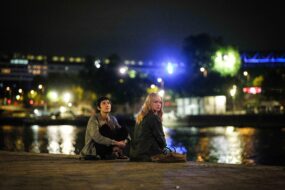
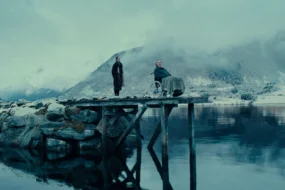
Crossings is a film that comes back from afar. Released in 1982 and first film by his director, Mahmoud ben Mahmoud, it had a great impact on the Arab world upon its exit, before gradually disappearing from collective memory... Thanks to the Cinematek's initiative, the film was restored in 2021 and can start talking about it again. An autobiographical narrative, he highlighted the sometimes absurd situation of borders and already portrayed the complex migration situation in his time. Its contemporaneity could make it pale more than one, as if nothing had changed in forty years.

Cinemamed

A technique that goes through time

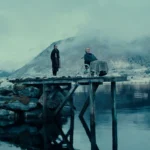
A boat leaves the port. Behind him, the dock moves away. Slowly, the hold closes, until the light passes away. Generic. Next plan, a lateral journey on a queue, filled with people of diverse and varied origins. As the camera slowly pulls up its tail, buffer planes fall like the authoritarian cutters of the customs officers they are, haunting the clear movement of the camera. Not a single word has yet been spoken, no character has ever been seen that everything is already there. The boat as a place deprived of liberty. The horizon disappears without return. The supreme power of customs officers, armed with their tampons. Their authority alone decides the fate of the little people who move forward.

Crossings
Youssef and Hamid in full confrontation at customs.

The film has hardly begun that a true intelligence of editing offers to the viewer. And that doesn't detract from the rest of the movie. It is the work of Moufida Tlatli, a regular of Tunisian assembly benches. Eight years later, she won the Golden Camera in Cannes for The silences of the palace, a film written, directed and edited by him. The restoration is also of exemplary quality. The photograph of Gilberto Azevedo is striking and has no doubt regained its superb past. At the end of the session, the director confided in his film all the defects proper to a first jet, but the images are there to deny it.

Comedians who cross the screen

The two main actors, Fadhel Jaziri and Julian Negulesco, splatter the film with all their presence. They are Youssef and Bogdar, Tunisian anarchist and Slavic communist respectively. Denied both at the British border and at the Belgian border, they found themselves blocked on the ferry, in a series of round trips between Ostend and Dover. Nobody knows what to do with these two strangers that everything opposes. By the force of things, their respective solitudes bring them closer. They care as they can, caught in the loop of their condition. Philosophical and political discussions animate their days, each exhibiting its own vision of the world and stoking at nightfall. Crossings is paradoxically a film that is both talkative and introspective, for Youssef, his main character, remains resolutely mutic. He finds in his silence the freedom that is refused to give him.

TRAVEL
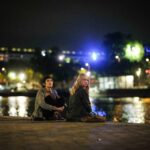
Youssef walks, accompanied by his new comrade

One last crossing for the road...

Puis vient le moment de briser l’énergie mise en place jusqu’alors. Mettre fin au duo. Alors que le désespoir pousse Bogdar à trouver une porte de sortie dramatique (à nouveau dans une séquence au montage brillant), Youssef se retrouve seul. La dynamique du film change totalement, rentrant encore plus dans l’introspection. Comme si, loin désormais du vacarme du Slave, les pensées de notre protagoniste se laissaient à entendre. Mais la Nature ne supporte pas le vide et très vite, une nouvelle rencontre permettra à Youssef de combler sa solitude. La romance qui commence alors rend vaporeux et mystérieux, ce ferry auparavant si pesant. Les traversées infinies de Youssef n’ont pas pris fin, mais elles ont pris un tournant plus doux. Un tournant qui poussera aussi le film à desserrer son étreinte si savamment tenue jusqu’ici. Il perd en puissance dans un dernier acte ce qu’il gagne en optimisme rêveur. Une pointe de déception qui n’amoindrit pas le reste du film, dont la force toute particulière me hante encore au moment d’écrire ces lignes.

Still small fret in the ocean of cinema, I swim between the classics and the latest novelties. Sometimes armed with a pencil, sometimes with a camera, I observe and learn big fish, ancient coelacanth bicolor, great white oscarized shark and thousands of sardines so well preserved.


0 0 Votes
Evaluation of Article
Subscribe
Notify of
guest
0 Remarks
oldest
most recent Most popular
Comments on Inline
See all your comments
EnglishenEnglishEnglish
0
We would like your opinion, please leave a comment.x