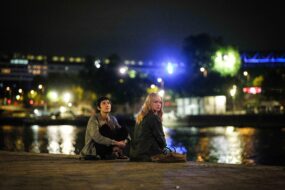
Presented in competition in Cannes, The Old Oak Have the handkerchiefs drawn in the room by its accuracy and pitch. Ken Loach signs a new social odyssey at 86 years of age at the height of Men: history with a little h as the historian Gérard Noiriel claims. While Syrian refugees are welcomed in a former mining village in north-east England, a village swept away by deindustrialisation, the feeling of decommissioning is gaining a part of the population. TJ Ballantyne, owner of the bar on Old Oak, must reconcile the irreconcilable in this desolate village, victim of a blind globalization to the misfortune of men.

Cannes signature 2

And what color is red? Red is the color of blood!

A committed artist, Ken Loach continues to revisit the social changes and fears revealing the ghost threats of our time. The TJ bar is as much a vestige of a past era, with its photos of the working world displayed on the wall as a will, as the last place of life of a village bruised by decades of deindustrialisation. Like cities exclusively oriented towards industry, red brick is available at each block. Reproduced identically, it is the symbol of the same social class; the proletariat, sinisterly atomized by wild and predatory capitalism. Mirror houses that recall - in a completely different register - the cynical monologue of Poelvoorde on « the colour of violence » in It happened near you.

A significant section of the local population is impoverished and reduced to a minimal existence, whose joys are summed up in the exchange of counters and the memorial impulses of a fallen, if not fantasized, era. Counter pillars hold the pub by their only drunkenness and in the midst of this sinister canvas: TJ, tavern tired by years and prisoner of long-standing relationships.

A man silenced in order to hold his bistro without frowning the voids of his meagre clientele, persuaded to hold the shop with great reinforcement of hops. A hostage-taking that forces the tenant to endure the frustration of his regulars, plagued by resentment cultivated by ignorance and distrust of difference. It is however TJ that acts as a binder in these modern ruins that should be rebuilt. The word community comes back several times while its elements seem so separate. Finally, the film answers a fundamental question that should never be ignored:

« How do despair, injustice and feelings of impotence affect how one considers one another? How can this context lead to fear and hatred? »

Instead of choosing an inquisitorial approach, the empty speeches of the village's bastards are looping, until exhaustion. Like a derailed vinyl. Here no need to « absolute villains, a feeling of injustice can push people to extremes, but their behaviour is always motivated by some logic. If we miss this dimension, we impoverish dramaturgy. » As Ken Loach suggests.

Impressive, TJ oscillates between the speech that would deprive him of his only clientele and the renunciation that has long won a man with lost illusions. From strikes without tomorrow to the distant memories of his father who thought hard as iron that the workers are not aware of their power and that they could yet overthrow the world at every moment, TJ is a dead among the living, a false believer disillusioned by life. It is the eruption of these Syrian refugees that literally upsets the beliefs of this downgraded but proud village. A glimmer of hope that becomes a beacon in the dark night.

Fascism is gangrene in Santiago and Paris

Perhaps Ken Loach's strength lies in his ability to cultivate a sense of optimism without ever falling into mint or cheap pathos. The portraits sequence in all modestness with fixed planes without fioritures and which faint from a rudimentary melt. Ken Loach gives as much freedom to the monologues of the frustrations won by racism as to TJ's anger impulses caught up in his own trade, as he approaches the beginning of the game of Yara, a Syrian refugee whom he supports with a humanism with fleur de sac.

The locals will not be willing to get to know each other or even enjoy each other. Against all expectations, reactionaries, whether convinced racist or simple opportunistic, remain minority. TJ and Yara have a very sincere relationship. This is neither fraternity, nor parenthood, and much less flirtation. A relationship all that there is more human, while TJ, a rather silent character at first glance, contains a goodness that only the skins of life know. Actor Dave Turner delivers a performance marked by the correctness and measure of the former resigned sometimes caught up in the anger of injustice.

While the grip of the village's old breakers seems to escape, local initiatives seek to (re)link refugees with the local community. Far from cultivating the happy poncifs of the ass-benits, The Old Oak Demonstrates a sincerity that dies the screen. Ode to sharing, Ken Loach's film once again recalls that the keystone of our hope lies in our ability to integrate and consider our same social class beyond our differences.

The Old Man and the Sea

By his modesty, the spectator never finds himself crushed by the realization, always about. Ken Loach signs a new film that is deeply altruistic, without artifice and carried by the strength of his dialogues alone, in addition to some of the poetic impulses left between two confessions: those of an ordinary man caught up with adversity. Paul Laverty, screenwriter of the film, explains how he was affected by the testimony of a nurse over 9O years of age treating the wounded following the 1951 Eastington mining disaster, where 83 miners had died:

« Vibrant testimonies such as his - and those who had taken part in the major 1984 mine strike - were emblematic of a deep sense of solidarity, social cohesion and a political vision that clearly contrasted with the despair that characterizes many people today. »

Never hare, simple but not simplistic, The Old Oak bears his name well and recalls how the oak, symbol of resistance, justice, communication, hospitality and generosity is our only escape. While the extreme right-wing attack in Saint-Brévin has been doubly successful in putting an end to the project of a refugee centre and to the mandate of a tirelessly intimidated mayor, The Old Oak maintains a confusing proximity to the real.

Also, by the sincerity of his speech, Ken Loach is giving a new lesson in cinema, beyond the one denunciation that is all too often known. The authenticity dear to the director no doubt draws its roots from a casting of mainly amateur actors from the region, outside the Syrians. A positive act in an atomized landscape. The effect is also reinforced by a successful photography thanks to a film capture Kodak 35 millimetres that gives a sorry stamp and sip of hope at the same time, in perfect harmony with the film's purpose.

Winning the Golden Palm would be a strong message as the executive locks in an alternative reality that cultivates division and maintains a criminal blur on the migration issue. At 86, by signing a film resolutely focused on optimism, Ken Loach gives us a lesson of modest and sincere humanity rather than a suicidal will. A life lesson and an invitation to mobilize the necessary hope for any society.

JV critic and film always ready to lead Interviews at festivals! Amateur of genre films and everything that tends to the strange. Do not hesitate to contact me by consulting my profile.

0 0 Votes
Evaluation of Article
Subscribe
Notify of
guest
1 Commentary
oldest
most recent Most popular
Comments on Inline
See all your comments
the celest wolf
Administrator
2 years

Looking to the future without closing your eyes to the darkness of our time, the latter (?) turned humanism for the « Old oak » is invigorating even if naive. And in this ultimate place of social bond where the relationships between the customers are authentic (a duo with the tuning) and the artisanal beauty of the certain frame (a magnificent 35 mm Kodak capture), everyone needs a « Marra » when society remains indifferent to poverty.

1
0
We would like your opinion, please leave a comment.x