Iran's film industry continues its international adoration. After the critical plebiscite of The Tehran Law about which we also wrote a Article, Black Market (The Slaughterhouse) was also presented and awarded by the jury at the 38th edition of the Reims Police Film Festival. This polar recounts the story of Amir who returns to live with his family in Iran after being expelled from France, a country of human rights. warm welcome that the Hungary... Barely arrived, Amir is involved in a sordid affair through his father, Abed, who finds himself making up for his boss the suspicious death of workers, mysteriously deceased in the cold room of the slaughterhouse where he is night watchman.

And for a few more dollars...

Beyond an intrigue and a rather classical process, it is in its context and approach that The Slaughterhouse stands out. Rather than multiply excessive twists, the director Abbas Amini prefers to proceed by narrative impulses with a continuous rhythm and sober planes, but sufficient to install a palpable tension at each moment. Amir is immediately rushed into an uncontrollable situation, the family of one of the deceased working tirelessly to reveal the truth. As for his father Abed, it is the very figure of the cowardice and the voluntary servitude to natural authority embodied by his boss. He ought to him, his life, his job as a well-known neoliberal old adage wants.

The father is willing to share, if not almost shoulder the burden of responsibility of this « accident »even embarking his own son in guilt and illegality. The paternal figures are reversible and Amir builds an ambivalent relationship with his father's boss despite him. It thus slowly slides towards the trade in dollars and livestock resale operating on behalf of this cynical businessman, who never gets his hands dirty. A juicy market of misery and topicality as the director raises:

« Right now, as we watch the film, the US dollar is a decisive issue on the Iranian market. Every day, the US dollar becomes more expensive because of the embargo and the very fragile economic situation. And to make a living, people are forced to buy and sell US dollars and get involved in eccentric business that leads them to difficult conditions. »

Amir had been expelled from France. Not much better received in his own recomposed family where – symbol rather than least – his suitcase is always ready to use to get back on the road, Amir really has his place nowhere. Its carrying is the fate of a broad phantom of the unworked Iranian society that simply seeks to survive. Caught between the dictatorship and the sword of Damocles of American sanctions amplified following the withdrawal of the Vienna Agreement Under Donald Trump's mandate, the Iranian people were the first to suffer the horrors of the US-Iran conflict over the thorny nuclear issue. The precariousness is gaining ground, the challenge is rumbling and the legal prospects, fatally, are diminishing. Inflation is galloping at more than 45%, unemployment is exploding and brain drain is accelerating in a country where 95% of the population is literate and has access to a high level of education. Women are most likely among the most active and educated in the Muslim world. The cultural world, particularly active, is facing a fierce repression of the regime. American obstinacy and Iran's hatred widely promoted by the predecessor of Biden and the hawks of the Republican party counterproduces Iranians.

Escapers of poverty

Abbas Amini watermarks a broken society, where predation reports are the golden rule. From the slaughterhouse to the black market of dollars, there's only one step. Everyone is the executioner of others or rather « butcher » of his next as suggested by the English titleThe Slaughterhouse. It is an impasse that appears here, that of a world that was once preventable and yet constrained by a social and political atmosphere that suffocates all confidence in the Human. In a vacarme to give migraine, dollar marketers simmer to negotiate the resale of green notes and sheep trading. Some come to their hands, others faint. This scene ironically recalls the Far West and anarchy of the early Wall StreetPlus misery. Everyone seeks to pull his pin from the game, to manipulate the prices to artificially inflate the gains or to comply with the rules of this « protolegislation » I'm sorry. The extras themselves were customary in these practices, as the director recalls:

« Repeatedly, when I started explaining to them how these markets work, many of them knew it well. And I discovered that the extras that were there to play in the movie, do the same thing regularly. They knew how to buy and sell US dollars. And it seemed so strange and painful to see that people who were there to contribute to a cultural, artistic activity, were mainly involved in buying and selling US dollars! This day was unbearable to me, but it gave rise to an intense scene during the shooting. »

How can we show solidarity when guilt gnaws the hero, an accomplice despite him and when he only wanted to protect his father? The touching relationship between Amir and Asra, the daughter of one of the deceased, is a constitutive of such an impasse. The latter and her brother decided to invest the court of the family home, well aware that the disappearance of their father was not unrelated to the family of Amir, who maintained relations with the disappeared until the eve of his last call. « You're a liar. » Asra, while Amir is swallowed up by fault. The image of the slaughterhouse and its butcher, too, is symbolic. The latter kills but for others, by profession and never by passion. Like all those exploited who seek only to satisfy their basic needs, the industrial equator is only a working of an infinite production chain, destined to erase the individual, whose will is less a matter of opportunity than of survival. The characters of Abbas Amini, each in their own way, are masters of so few things.

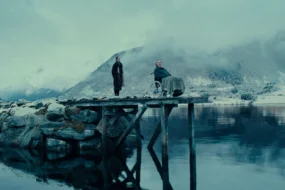
In addition to directing and playing a quality actor, photography is a success, suddenly turning blue tones to an orange palette, from night to light, from Persia to the Arab world. Having chosen Iraq as a mirror, another territory ravaged by decades of American conflict and interventionism is not insignificant, on the contrary. The strategy of the economic node rather than the promotion of local social policies is a sinking of every new conflict. A radical aesthetic choice that breaks down and reminds us that the first victims of international rivalries are often civilians. With Tehran Law, Black market gives a fresh breath to Iran's film industry, particularly represented this year. Release scheduled for January 5.

JV critic and film always ready to lead Interviews at festivals! Amateur of genre films and everything that tends to the strange. Do not hesitate to contact me by consulting my profile.

0 0 Votes
Evaluation of Article
Subscribe
Notify of
guest
0 Remarks
oldest
most recent Most popular
Comments on Inline
See all your comments
EnglishenEnglishEnglish
0
We would like your opinion, please leave a comment.x