Presented at the 77th edition of the Cannes Film Festival, Shrouds David Cronenberg had received more than a warm welcome there. A year later, when it was released in theatres, it was the turn of the general public to show some reservations about the last delivery of the body horror virtuoso. On the occasion of its release on DVD, Blu-Ray and 4K UHD at Pyramid VideoLet us return to one of the most confusing works of 2025.

Cameras in the Hereafter

A former producer of industrial films, Karsh (a name strangely close to the title of a previous Cronenberg film, also featuring a producer with unhealthy fantasies) has developed a concept of connected cemetery called GraveTech. The principle: wrap the remains of the deceased in a shroud capable of generating a faithful reproduction in three dimensions and in very high definition. When his wife Becca's grave, as well as a few others, gets vandalized, Karsh will be looking for the culprits and reasons for their actions.

Having lost his wife a few years ago, Cronenberg makes a cathartic film here, where he continues to explore some of his favorite themes (the study of the flesh, its post-mortem evolution, and the morbid fascination it brings) by mixing them with mourning, with the questions it raises. What happens after death? What happens to those we love? Like Cronenberg, Karsh does not support this mystery, this unknown as abstract as palpable. There's soul, and there's body. Becca's soul, however, is not Karsh's primary concern; She continues to live in her memories, in her feverish dreams, until she makes him hallucinate. No, what torments him is his body. This body mutilated by cancer, gradually eliminated, but still filmed with a touching softness by Cronenberg's camera. It is during these nebulous dreams, of which we never really know whether it is a matter of reminiscences or illusions, that Karsh's love, and by extension, the director, expresses itself truly, without outpouring, but through tender eyes, despite the perpetual degeneration to which Becca's body is victim.

Serious voyeurism

This is where GraveTech's interest lies: allowing the grieving husband to follow the evolution of the rotting of his wife's remains, in the continuity of a process already begun during his lifetime. This mutilator etiolement, initiated in normal times by death, is here a bridge between the world of the living and that of the dead, for Karsh cannot resolve to deprive himself of knowing its outcome before complete annihilation – before Becca's body becomes dust again. Moreover, it is this lack of religious faith, this fatal atheism that he cannot undo, which drives him to create a technology that combines morbid voyeurism and cathartic comfort. Only Becca had a twin sister, Terry, a reassuring presence, as she reminds her of his wife's body when he was still integrity, but also disturbing, precisely because she is a mirror of Becca. How can we succeed in mourning the loved one, when an identical replica of it is within your reach?

Existential telefilm

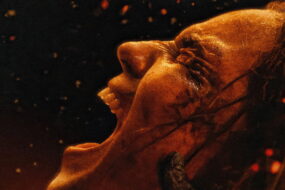
LFlesh is an unlovable film par excellence. If all Cronenberg's films have more or less divided the critics and the audience, it will probably remain one of the most confusing, as it multiplies the austere choices of realization. The image is clear, smooth, too smooth, the camera still, just like the actors; There is very little movement, but a lot, a lot, a lot of dialogues, to such an extent that it would sometimes come to wonder whether a novel would not have been more appropriate to tell this story. In fact, apart from the few visually striking scenes (Karsh who wraps up in one of his shrouds to get a glimpse of what the dead feel, before realizing that the dead no longer feel anything, or even, and above all, this scene of love dreamed with an estropiated Becca, where the work of sound proves as icy as it is remarkable), the film has a telefilm aesthetic, of course, but which can be disconcerting, even disappointing, at first viewing.

In addition, the plottist shift midway from intrigue will deconcentrate more than one, even if, a posteriori, Cronenberg's writing reveals much more finesse and accuracy than would be granted at first sight. This plunge into absurd fantasy, into paranoid theories, is ultimately only the logical evolution of the path of a man who fails to grieve, and thus seeks an escape, a solution however unlikely, that can explain, rationalize the death of his wife. Why her? Why so early? In the absence of faith, conspiracy assumptions may be used as the last resort to brave the pain of absence.

Cadaveric coldness

The result is a complex, fair and sincere film whose (voluntarily) sleek dressing is more towards utilitarianism than any cinematic aesthetic. In the background, Cronenberg deliberately robs his film, refuses him any artistic excitement, preferring to film coldly a bereaved man who does not know how to manage his wife's death. But if Shrouds may be difficult to appreciate at its fair value during its viewing, however, there remains a work that remains, that takes root, and that will not leave insensitive.

Devouring twilight films, night literary translator and self-proclaimed specialist of Icelandic cinema, I track feature films at night and day, but especially at night, in order to draw from them the substantial mellow necessary for the survival of the hungry cinemaphile.


5 2 Votes
Evaluation of Article
Subscribe
Notify of
guest
0 Remarks
oldest
most recent Most popular
Comments on Inline
See all your comments
EnglishenEnglishEnglish
0
We would like your opinion, please leave a comment.x