« Satanist, anti-Soviet, anti-Russian ». Three words relayed in loop by Putin's most ferocious watchdogs. It was in these flowery terms that Michael Lockshin described the new adaptation of the Russian novel by Mikhail Bulgakov (1891-1940). Presented outside competition at Gérardmer Festival, The Master and Margarita saving neither of the two blocks through an incisive (and modernised) rereading of one of the classics of Russian literature of the XXe century. Back to this burning work with singular resonance with censorship yesterday and today.

The Master of the Kremlin upset

To better understand the scale of the project to adapt the novel and its resounding echo in Russia, one needs to be interested in the background. Behind this modern adaptation, there is first Michael Lockshin. Born in the United States, he grew up and lived in Russia, where he graduated from Moscow State University with a master's degree in psychology. He then moved to London, where he made commercials and food video clips. He was unknown to the battalion before 2019, where he signed Silverland: Ice City (2021), a first consensus Russian film for Netflix and intended for an international audience. By choosing to attack a monument of literature as complex as the work of BulgakovMichael Lockshin changed his pitch and managed to attract the lightnings of the regime which accused him of subverting the original work into a political burn.

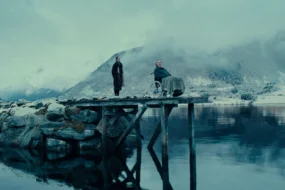
Silverland: The Ice City (2021)

Star host Vladimir Soloviev whom you certainly knew for his projections against the decadent West or the « Great Satan », seemed to question in his late-show: « How could this antipatriotic film be allowed? Is this a special operation? » Was he still insurgent last year. Very quickly erected as an enemy of the people, the propagandist galaxy at the service of the Russian regime quickly urged the opening of an investigation into the production of the film. As many Russian authors today physically threatened and considered as « Foreign agents »Michael Lockshin, who lives today in the City of Angels, is obviously persona non grata in Russia. The film is curiously passed between the meshes of the censorship net which has taken a completely different form since « [very] special military operation ». With a budget of $20 million and a big casting, the film had to be repulsed several times, mainly because of the pandemic and the withdrawal of the American studio Universal, which left the Russian market after the war in Ukraine began.

The Kremlin's nightingales sang in concert criticizing Lockshin's heretical adaptation

Before him, a previous director had already broken his teeth to adapt Bulgakov's destabilizing work in which several fragmented narratives overlap. It is thanks to Igor Tolstunov, producer of Russian films since the fall of the wall and Ruben Dishdishyan, a recognized businessman having with Igor acquired the rights of Bulgakov's work that the version of Lockshin will finally see the light. The Russian-American director has long been convinced (and certainly rightly) that « Bulgakov's novel [was] impossible to adapt ». The labyrinth structure is hard to give it wrong, but it shows a density that gives it vertigo. And yet the magic of seventh Art does its work. This narrative enchased as in Russian dolls echoes the tumultuous journey of the original work to find its letters of nobility.

The writer and his wife his wife Elena Sergeevna Bulgakova without whom his work will never have been born in its form that we know today

From Bulgakov to Lockshin

Struggled with disgrease by the Kremlin, Lockshin, in spite of himself, drew closer to Bulgakov's sown journey, which had suffered the lightnings of censorship. The writer from Kiev had to burn the first version of the book in 1928 after being warned that the authorities had banned his play. The Cabal of devotees. Even the bell sound in Lockshin's movie. Back to the wall, Bulgakov even tried to convince (unsuccessfully) Joseph Stalin who had loved his previous play Tourbine Days. He wrote to him a letter that was bold:

« The literary press was eager to show that my works did not have the right to a city in the Soviet world. I add that she was right. It's true, I admit: fighting censorship wherever and under any regime is my duty. »

What changed today? Lockshin did not write to Vladimir Putin; Nevertheless its name was removed from the poster and the two works separated from almost a century seem to contribute to a similar destiny. Ironically, his film met with a resounding success in Russia by winning last year the title of best start at the Russian box office. Like a dream that would haunt us the nights, Bulgakov's version will be entitled to several forms between 1927 and 1940. The final version will only be completed after his death thanks to the work of his wife Elena Sergeevna Bulgakova, who is not without recalling Marguerite. Fiction and reality intertwine in this ever-surprising protein work.

The Master and his muse as Marguerite presents herself.

Dangerous links

We recognize Bulgakov behind the Master's character. The playwright falls under the charm of the « witch » Marguerite, an unknown cross in a crowd bath in the heart of a celebration to promote a five-year plan in four years, stakhanovist ineptie that the USSR has well known at the top of propaganda. Their adulterous relationship will be the occasion of literary confidence, while the successful writer is reduced to answer for his work in front of the Soviet propaganda office which is concerned about the subversive character of his play in Judea. Too far from the imposed canvases of the supposed art guided the people towards the class struggle, his play with anarchist tone is debated during a puppet trial. The various figures of the regime that lock the author's words follow each other during a paradoxically tinted requisite of benevolence as bourgeois as hypocritical. There are replicas that question the People's Arts office about the Master's obedience to the Kremlin:

« All power is violence against ordinary people. »

We are at the heart of socialist realism aimed at promoting and ensuring the principles of Soviet communism. This utilitarian doctrine was established as the official art of the USSR in the early 1930s. This injunction to serve the masses through submission to the root Party after the Iand Congress of the Union of Soviet Writers in 1934. From this point on, all other trends are, with few exceptions, severely repressed and censorship is spreading drastically. If the full text of Bulgakov's novel is published only in 1966, twenty-six years after the writer's death, other authors will not have had this chance and will be deported to the Gulag, interned or completely eliminated during the Great Purges.

The scene of the indictment against the writer speaks for itself.

Lockshin's film will produce several stories that intertwine and intrigue with intelligence. There are at least three main structures to which other lower levels are grafted: the coin censored in the Judea of Pontius Pilate presented on the screen as if it were real; the relationship between the Master and Margarita, herself told by the author imprisoned in a twilight and retrofuturistic asylum. The accounts of the different registers respond and give substance to the history reported by the Master. It is up to the viewer to unravel the reality of fiction, the fantasy of frustration. And the reported speech takes part in linking it together, drowning the border between the fantastic and the real, the present and the past, all with a breathtaking mastery.

Woland's character crosses the movie from end to end.

It's a bit confusing at the beginning when we hear simultaneously a Russian dubbing superimposed on characters who sometimes express themselves in German, like the enigmatic teacher and his avatar Woland, embodied by Berliner August Diehl, remarkable in this ambiguous double role. Little by little, we can find the red thread of tales woven with malice and never teleguide the viewer towards a pre-made reading.

Neither God nor Master

Without falling into the trap agreed to break the fourth wall artificially, the film succeeds in turning half-words to the viewer, and more precisely to the Russian society that is said today to have acquired, perhaps too hastily, the imperialist designs of the Kremlin. This is particularly the case when the Master attends the play presented in place of his own in Judea. The latter boasts the merits of the regime and is immediately squashed by Woland's evil figure. The singers are invited to leave the scene by its unlikely acolytes, including this black cat who likes to smoke cigars. Woland, this Faustian mage which rests nonchalantly on her blunt cane of the head of Anubis, comes to propose an alternative and cathartic circus number in comparison with the Soviet version.

The Master's black cat and his double narquois, the cigar in the mouth.

It is the occasion to singer the imposture of the people of Mother Homeland, no less virtuous than that of the capitalist world. It would be wrong to see only a critique of Russia yesterday and today. Woland's cynicism has a universal vocation where Soviet and Western citizens are placed at the same level, which is displeased by Putin's ventriloquists. This is all the more so since Lockshin himself experienced both systems, the first five years in the USA and then in the USSR, from 1986 a few years before his fall. It was only later that he left to live in London after graduating in Moscow before settling in Los Angeles. Displayed defender of Edward Snowden, remember that Lockshin is very far from being beat and acquired at « the greatest democracy in the world ».

The Master and Margarita do not hesitate to despoil the communist varnish behind which his representatives shelter, while they indulge in lust in closed clubs which they refuse to the proletarians.

This cruel show of Woland and demonstration of the strength of the veality of the masses turns to black magic before reality returns to galloping. With a fondue all in elegance, the dancers reappear before our eyes for the nail of the show. It is the apotheosis: the artists complete their number boasting the future of Russia where the proletarians would be liberated from poverty. The Master also takes his minds back. Was Woland's invasion and these shirks just a hallucination? Or was it not a strong desire to have neither God nor Master. In watermark, this Faustian illusion may not be what one believes. The glamour of propaganda is well before our eyes.

The outcome of the film is an exciting staging.

This resolutely modern adaptation of the novel will not please everyone, if only for the freedoms granted in relation to the original work and its very theatrical tone that recalls Serebrennikov. But this is also what an adaptation of a work started more than a century ago requires. The Lockshin version is a great movie with fantastic outcome in every sense of the word. The novel, theatre, cinema and reality merge with maestria. Although he was presented out of competition, The Master and Margarita was certainly the best film programmed at Gérardmer. You are strongly advised to dive right now in SVOD, as Russia's campaign to reduce the influence of the film attests to a more improbable stage release. « My name doesn't even appear on the poster » fun Michael Lockshin at the media Vanity Fair. « The story is played first as a drama and repeats itself as a comedy » wrote the philosopher Jacques Ellul. Here we go.

Movie trailer

JV critic and film always ready to lead Interviews at festivals! Amateur of genre films and everything that tends to the strange. Do not hesitate to contact me by consulting my profile.

5 1 voting
Evaluation of Article
Subscribe
Notify of
guest
1 Commentary
oldest
most recent Most popular
Comments on Inline
See all your comments
trackback

[...] the brilliant German actor who dipped the spotlight in The Master and Margarita (read our review), delivers a stunning performance. His acting game is sublimated by the talent of [...]

EnglishenEnglishEnglish
1
0
We would like your opinion, please leave a comment.x