Unstoppable technique, extensive narrative, millions and millions of budgets... and yet a proposal for discourse on radical ecology? Is this the bet of James Cameron with Avatar: fire and ashesThe third part of the saga? It is from this angle that we will try to illuminate the huge blockbuster that excited the cinemas during the holidays. Between CGI explosions, buyiric acid explosions on the bridge of a whaler and explosion of skulls in Sainte-Soline, let us plunge into the story proposed by this immanquable film year 2025!
Never two without three
The third part of the saga of James Cameron Scrolls over the halls, taking in his wake his cars of spectators hidden behind their 3D glasses and their gigantic pots of popcorns. This pane starts in media, propelled into the life of Jake Sully ("incarnate" by Sam Worthington) and his family in the Metkayina clan. Devastated by the death of the Neteyam son, the family cell that irrigated the narrative of the second part dislocates: between hatred for humans (and, by corollary, for Spider's character) and a thirst for resistance, tearing operates. And it is without counting on the arrival of a new clan of Nasavi, pirate and unscrupulous: the Mangkwan. A tribe worshipping fire that willingly practises the policy of burned earth...
Let's get rid of the sponcif... Avatar: fire and ashes Don't reinvent the saga. One could even, without pulling on the rope, accuse him of some flemmardise writing. The film takes over the functional recipe of the first shutters: the same characters, the same full CGI environment, the same imparable technique, the same screen seams... And by mixing all this, Cameron offers us an gripping story, sometimes haletante, over a total duration – let's admit it – far too stretched by 3h17! Despite this, the feature film manages to never (almost) bother us, and it is already a form of exploit. The use of HFR questions, sometimes ultra immersive, sometimes a visually invasive strand, but it certainly ensures an absolutely unrivalled 3D quality. And even if all this is nothing new in the saga, it's already a pretty good point for this third part that can take its spectator from end to end.
Three colors: blue, blue, blue
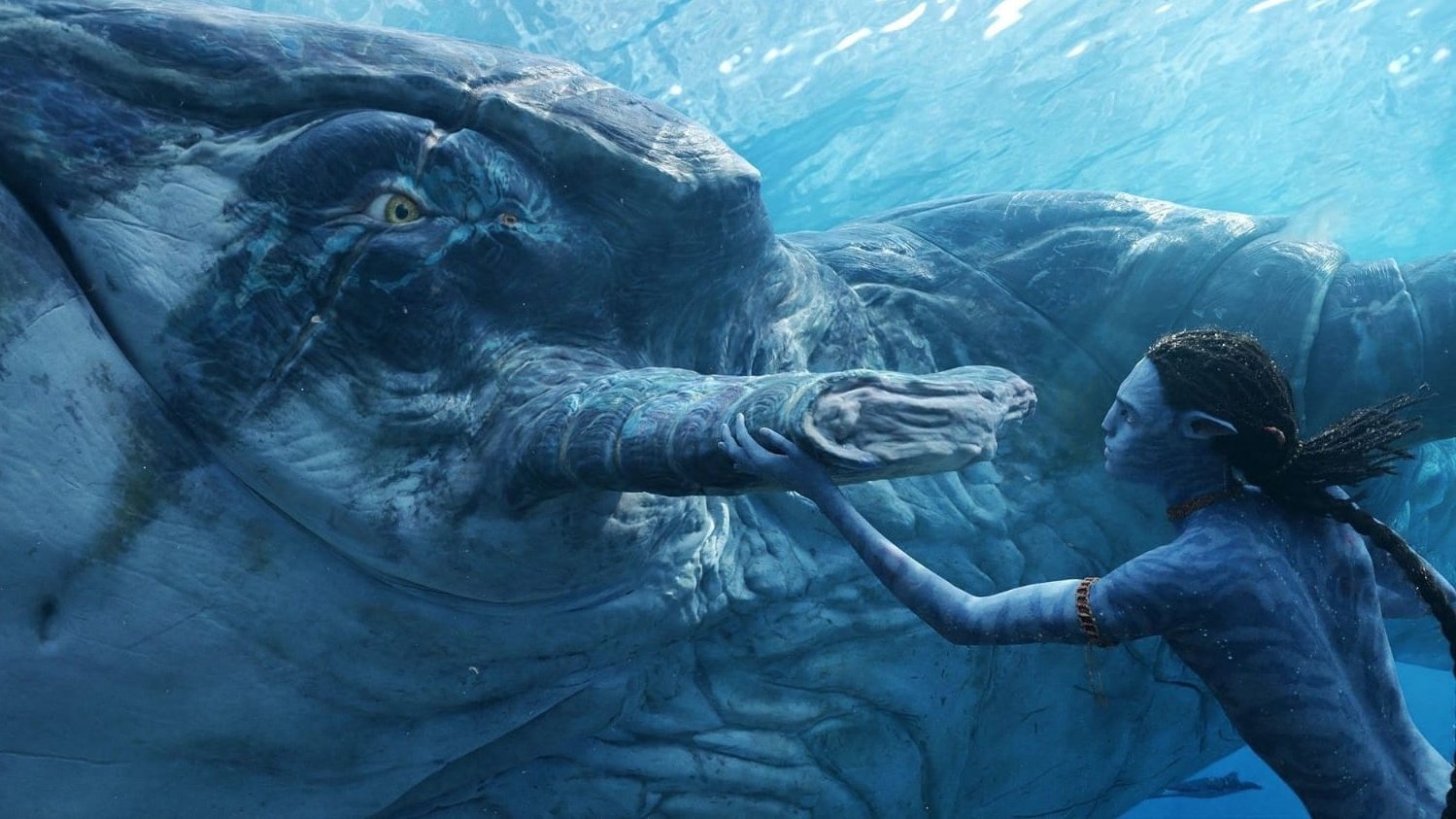
Neteyam, in the second part of the saga, dies to defend his ideas, his principles, but also to defend a non-human creature, the tulkun. Not very complicated to assimilate this huge, intelligent marine animal, organized in family cells, to the whales of our little Blue Planet. Not very complicated either to make the connection between the Nassavi who defend this cetacean body and soul, and the environmental activists sauce Sea Shepherd. Piracy flag, up to assumed botism, activism that never allowed the association to be hacked by financial governances in contrast to other sector mastodones such as Greenpeace or WWF, Sea Shepherd advocates total non-violence. The association does not hesitate to attack directly on the equipment: sunk boats, sabotage, collisions, media play, etc. Everything is good to scratch the enemy – much more powerful, armed by capitalism – a few millimetres in this endless obstacle to the struggle for the living.
The question that has been asked to Lamya Essemlali, the president of Sea Shepherd France, before her first mission at sea and when she had never seen a whale with her own eyes, was the following: are you willing to give your life to save a whale? She said yes. In Avatar Second, Neteyam would probably not have responded differently by talking about a tulkun. And in fiction, he died... James Cameron lead us into a history where ecology remains a central theme, but where a certain gap occurs. A shift towards darker, crueler, more intimate themes. An ecology where the struggle can – at any moment – marry death, with mourning. A tired ecology...
Fatigue is not individual, but the structural effect of an endless conflict, where the enemy always returns, stronger, more cunning, better armed. On the one hand, the dominants and their armada – technological, extremist, military – who delegate to paid subordinates, mercenaries but proletarianized, the looting effort. On the other side of the barricade the resistors who only have their bodies to oppose them. Successes are usable, and the promise that the worst remains to come tarnishes every victory, even minimal. This was the case for each Antarctic whale defense campaign for Sea Shepherd, the very American series Whale wars Testifies. This is certainly also the case in all the militant spheres – anti-racism, feminism, environmentalism, trade unionism... – a Socialter article on reports in an exciting way. And definitely, this "big fatigue" doesn't save Pandora. We'll come back...
But until the second stage, the violence instigated by the Nasavis against humans was nothing but a purely emotional reaction: the shock of a people in reaction to the destruction of their world. In other words, Cameron was morally legitimizing her, but did not offer to think politically. And that changes radically in this third part.
Legitimation of violence
Where is the violence in our Western societies? The question is asked by Avatar, third part. The question is even put to the viewer, directly. And the answer lies in a memorable sequence of the second third of the film, where Jake Sully finds himself trapped in a glass cube. So far, identification was not complicated: on one side the wicked (armed, violent, greedy), on the other side the peaceful beings asking only to live peacefully in their immaculate nature... Of course, the spectator would be happy to join the Nasavi. But during this pivotal sequence, Jake Sully finds himself humiliated, dragged in the middle of a human tide, a tide of screens also, a tide of us. All this before being thrown, handcuffed, into this glass prison. On one side, blue, giant, alien, lonely; on the other side, a host of well-human spectators, riveted on their technological gadgets, haunting, contemptuous. Identification is blurred, becoming less easy. Where would we be if we were immersed in this world? Would we really be on the side of the exception, the margin, the resistance? Or would we rather remain passive to watch the world swallow, distracted and captivated by our technological bagatels...
The answer depends on the sincerity of its speaker, but it prompts us – beyond the 3D glasses – to realize that we are living in a Western society that is certainly civilized, certainly at the technological cutting edge, but above all based on a need for constant, return, systemic violence. A violence that is hidden, that is discreet and sinuous, that is «decides with PowerPoint» as Nicolas Framont writes in his brilliant and recent essay Saint Luigi. A fuel violence, vital to its survival, but perfectly invisible, encrypted in patterns of domination integrated and replicated with the envi.
To learn to name such violence – racist, sexist, class, prison and police violence, violence at the border, violence at work, symbolic violence in the Bourdieusian sense of the term – is to understand, in mirror, that a beat discourse of pure non-violence will serve nothing other than to protect the established order, than to strengthen the current state of affairs. "Violence is dangerous, but the status quo condemns us. We must learn to fight in a world on fire", said Andreas Malm in its illuminating test How to sabotage a pipeline, and this sentence could be inscribed on the frontispiece ofAvatar: fire and ashes. On Pandora the world is really on fire, and violence is now thought not as an emotional response, but as a political strategy. Even the tulkuns, peaceful beings in essence, are working together to make the decision to seize this violence. The verdict is painful, but implacable. And this violence is transformed into a tool, thought strategically and rationally. It becomes a fundamental element of the struggle.
The second part proposed the ecological struggle in sublime, blissful, heroic tragedy. The third strand pushes the reflection. The struggle becomes organized, increasingly disembodied from his heroic corpus to become structural. Violence is redistributed to responsible infrastructure. Ecological anger goes from pure affection to the force to organize, even if it breaks with the moral comfort of pacifism. Resistants become The Living Defender.
The Living Defender
Maybe we're touching that on what's most annoying in Avatar. Why? James Cameron Does he need 400 million dollars – a figure that already gives the vertigo while he does not even integrate the pharaonic budget promo – to film real transvestite by CGI? Why film Pandora instead of Earth? Why does he not embark his teams on the ground, around the world, to capture real struggles? To film over the shoulders of the activists of Sea Shepherd the horror of the red fjords of blood during the barbaric massacres of globicphales in the Feroe Islands or the ridiculous but tearing whale hunts orchestrated by Japan? Why doesn't he send his cameras to the heart of the action of the Earth's Uprisings against Lafarge, a flash mobilisation that has inflicted on the immense polluter major damage? Why isn't he filming the blown mouths of Sainte-Soline, where police troops overliven by the warrior speech of an incompetent Prime Minister are vulgarly falling on clusters of protesters opposed to the outlying Mega-bassins? Why does he not capture the militant burn-out by questioning the first concerned rather than representing him with his pretty blue characters?
Lots of questions, few answers. And then there is only a disappointing hope of seeing this kind of huge mural with sauce Weiwei in Human Flow but transposed to ecology. Probably that's not what interests James Cameron. More certainly because no one would spend that «crazy money» for that kind of movie. Financials are obviously not stupid enough to pour their dollars into the pockets of a film that proposes – little or no – to swallow them all raw. On the other hand, when the same message is transposed to a fictitious planet, with fictional creatures and whales, the pill seems resolutely better. And if this fiction becomes ultra lucrative, then why deprive it? Beast or opportunism, you decide. However, the film exists and offers Hollywood a speech of a radicalism that is quite enjoyable for an industry that is as steeped in its financial machinery as its incorruptiblebourgeoise.
However, the film described above with this puzzle of questions exists, that it was released no later than this year and that it was produced in France. The Living Defender traces the career of its director, Vincent Verzat of the channel Share it is nice, sewn between naturalist learning and the path to activism. Astonishment for a nature so foreign but yet so close, the appearance of multiple threats in the form of hydra that at each beheading pushes back to the hundredfold, the militant fatigue that awaits a body crushed by these asymmetrical battles against the forces of death, the victories so fragile that one celebrates already looking for the next threat... One Avatar Without Na James Horner, the absurdity of a power in the process of fascisation that causes unspeakable violence against resistance shoots.
It makes little sense to send back the two films back to back, but their almost simultaneous releases leave a dream. Even more so than beyond its small budget, which is largely driven by crowdfunding, The Living Defender is also censored by some town halls on the right like in Suresnes, where the projected projection is simply cancelled « After analysis of political content »... (see above)Article Reporterre). So it's not just a film that's playing here, it's a climate. Censorship of the film The Living Defender, as the cancellation of cultural events yet peaceful and explicitly progressive – lAntifa Fest version 2025pressure on critical humorists or increase in gag procedures against the small independent media being just a few examples among so many – says something of the time: an authoritarian stression that does not yet say its name but already applies its reflexes.
We don't burn works, we remove rooms; we don't ban frontally, we « cancel »public order, neutrality, propriety are invoked. Critical culture becomes a risk, political ecology a threat, and any attempt to think the world other than through the logics of profit or domination is relegated to the rank of provocation. In this context, the very existence of Living defending holds the act of resistance. Not heroic or grandiose, but obstinate, fragile, deeply human. Where Avatar offers a spectacular catharsis, this film recalls that the struggle has nothing to do with a distant myth: it is here, now, exhausting, often lost in advance – and yet necessary. Institutional violence is rising, cultural counter-powers are receding, but the narrative is not closed. Maybe he's just starting.
Drinking the Stephen Kings as the apricot syrup of my native country, I first discovered cinema through its (often bad) adaptations. I'm married to Mrs. Wilkes as much as a persistent Stockholm syndrome, I am gradually opening up to videoclub films and B-series peasers.Today, I wander between my favorite cinemas, film festivals and the edges of Helvetic lakes much less calm than they look.

Categories
Recent Posts
Le grimoire de bord du 33e Festival
- 5 February 2026
- 52 min reading
The Dark Rites of Arkham, pulp &
- 3 February 2026
- 4 min. of reading
Neil Marshall, downhill to Gérardmer
- 1 February 2026
- 2min. of reading
The 4K Ultra HD Bazaar, volume
- 26 January 2026
- 56 min. of reading
Avatar, the living (digital) who defends himself?
- 22 January 2026
- 13min. reading


An exciting (and passionate) angle about Avatar and its mirror effect which also mss questions, as often when it comes to blockbusters. Finally, it is very close to what Guy De Bord could have said today in his theses about the show society. "In a truly overthrown world, true is a time of falsehood."
We're there and not just a little bit. We can be fascinated by Avatar for 3h17, "feel Navii" with his popcorn bucket loved between his legs and, at the exit of the film, go yelling at these damn "green Khmers" by returning home in SUV! 🤷
"Curious" popular success to parallel with the immobilism of the present, at least of the mass in the face of the collapse of living, animal and plant, as mineral. Water is lacking, rare minerals open the wars of tomorrow and extractivism is in full swing. We could apply the Ship formula to Greenlanders whose sovereignty is never questioned.
It's not a crisis as the media like to say. The crisis presupposes a transition from one state to another after reaching a peak. Modern capitalism is not in crisis, it is a system of total destruction that must create ever more value by exploiting its environment.
There is never a question of a real transition or a democratic choice to another system, whatever the state of suicidal places shared unanimously by science. In Greek the word crisis refers to judgment, to the ability to choose. Associated with the lexical field of the disease, the crisis is supposedly transient before remission. Diagnosis, we've already established it for decades and yet nothing...
In this, the comparison with the immobilism of the Naviis and the feeling that Avatar runs in circles between violence and non-violence in the face of the roller compressor machines that always apply the same method is very interesting. I didn't think about it. Thank you very much for this analysis. Obviously Cameron didn't theorise it, but, unconsciously, I'm sure that explains in part why the film constantly recycles.
It says a lot about the paradoxes of our time. And it's nice to read you again.
Ciao and thank you so much for your review 🙂 and indeed your comment on the use of the word "crisis" misdirected from its meaning takes here a very special turn...
Very nice article! Hyper interesting angle that pushes to reflection, thank you for this quality content 🙂